I once watched a leadership team spend three hours agreeing on the word “bold” as a brand value. Bold. For a company whose last major product decision had been to not change anything. The facilitator wrote it on the whiteboard. Everyone nodded. It went in the Brand Guide.
Most of the time, a “brand problem” is really a question of whether we’re willing to look in the mirror and name the gap between what we want and what is. The framework below is, among other things, a very uncomfortable mirror.
Brand incoherence almost never shows up as a “brand” problem. It masquerades as a sales problem, a retention problem, a culture problem, an NPS problem. It shows up as a customer support queue that never gets shorter, a marketing budget that keeps growing without delivering on what it promised, and leadership time spent managing the distance between what the organization says it is and how it actually operates. (The tell, if you want one, is when the proposed solution to negative sentiment is more advertising: reputation management with better fonts.)
At Takt, we’ve been running a diagnostic framework called the Corporate Brand Identity Matrix (CBIM) with organizations for six years, close to a hundred of them, across universities, global consultancies, purpose-driven companies, household names, and challengers who probably should have stayed challengers a little longer. That work has made one thing clear: articulating a brand is no longer the hard part. AI has seen to that. Organizations can now produce polished positioning, compelling language, and a coherent-sounding brand platform faster and cheaper than ever before. What they can’t produce with a prompt is whether any of it is true, or whether the organization is actually built to deliver what it just described.
For a long time, that was a survivable gap. A polished website, a well-crafted positioning statement, a strong visual identity: these things implied organizational credibility because they were expensive and difficult to produce consistently. That implied credibility was itself a competitive advantage, and it papered over a lot of gaps that nobody particularly wanted to examine. AI is in the process of making that advantage disappear entirely, and the organizations that haven’t done the internal work are going to feel it in ways they won’t immediately recognize as a brand problem.
The False Security of the Stack
Most brand frameworks are additive by design, which means they help you build rather than test. You start with purpose, work toward positioning, layer in values, add personality, establish a tone of voice, develop a visual system, and eventually arrive at a brand platform that has been structured, named, and translated into language. The structure implies discipline. A pyramid feels stable because it looks stable, and is digestible for a room of non-brand folks. A brand house feels coherent because the elements have been arranged in a way that resembles coherence.
Vertical order is not the same as structural integrity, though. The pyramid can be impeccably organized and still contain elements that contradict each other. The brand house can feel complete and still have no real relationship between the purpose on the top floor and the competencies in the basement. Most traditional frameworks are very good at making leadership feel like the brand has been built once its attributes are named and stacked. The question they rarely ask is whether the organization can actually deliver on the promise or position it’s claiming.
That’s an accountability question, not a messaging one, and most brand frameworks aren’t built to hold organizations accountable. They’re built to give organizations the feeling that the work is done, which is a different purpose entirely.
Where the Framework Comes From
Before I get into the argument, credit where it’s due.
The Corporate Brand Identity Matrix was developed by Stephen A. Greyser and Mats Urde. Greyser is a professor emeritus at Harvard Business School; Urde is a professor at Lund University in Sweden. They introduced the framework in a 2019 Harvard Business Review article, “What Does Your Corporate Brand Stand For?” and the foundational research behind it was published earlier in the Journal of Product and Brand Management in 2015, where they used the Nobel Prize as one of the original case studies.
Their core observation was precise: most brand frameworks were built for product brands, designed to help companies articulate what a thing does and why someone should buy it. When all a customer needs to know is that something is fast, reliable, or refreshing, a framework built around external claims and consumer perception is sufficient. Corporate brands are a different problem entirely. What’s being sold is not a product but the whole entity: its judgment, its values, its people, its culture, how it makes decisions under pressure, and whether it can be trusted over time. A framework that treats that as a messaging exercise is going to miss most of what matters, so Greyser and Urde built one that doesn’t.
We adopted the matrix in 2019. What follows is my perspective, built on their foundation and tested across nearly a hundred organizations.
Nine cells, three layers, one question
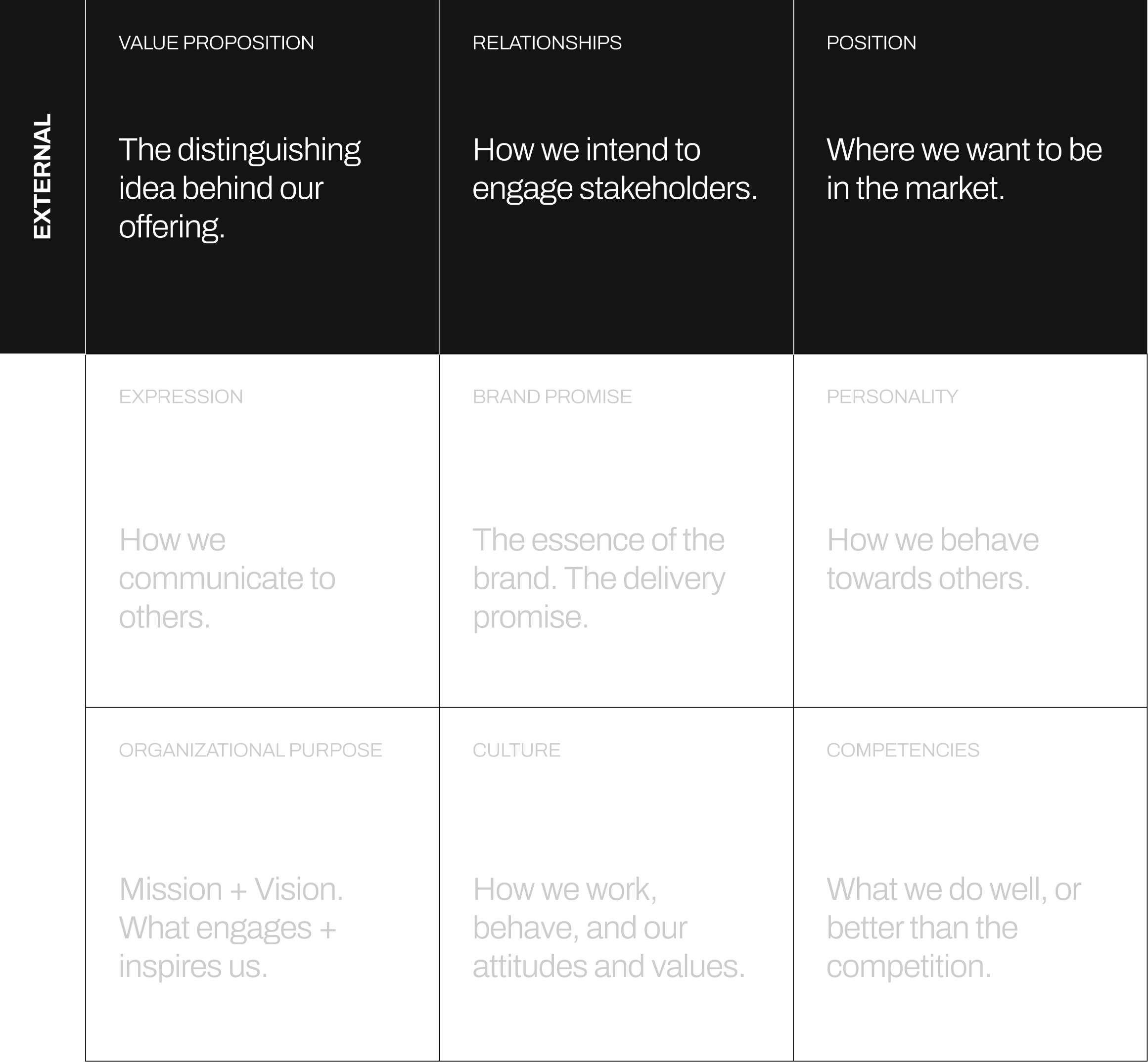
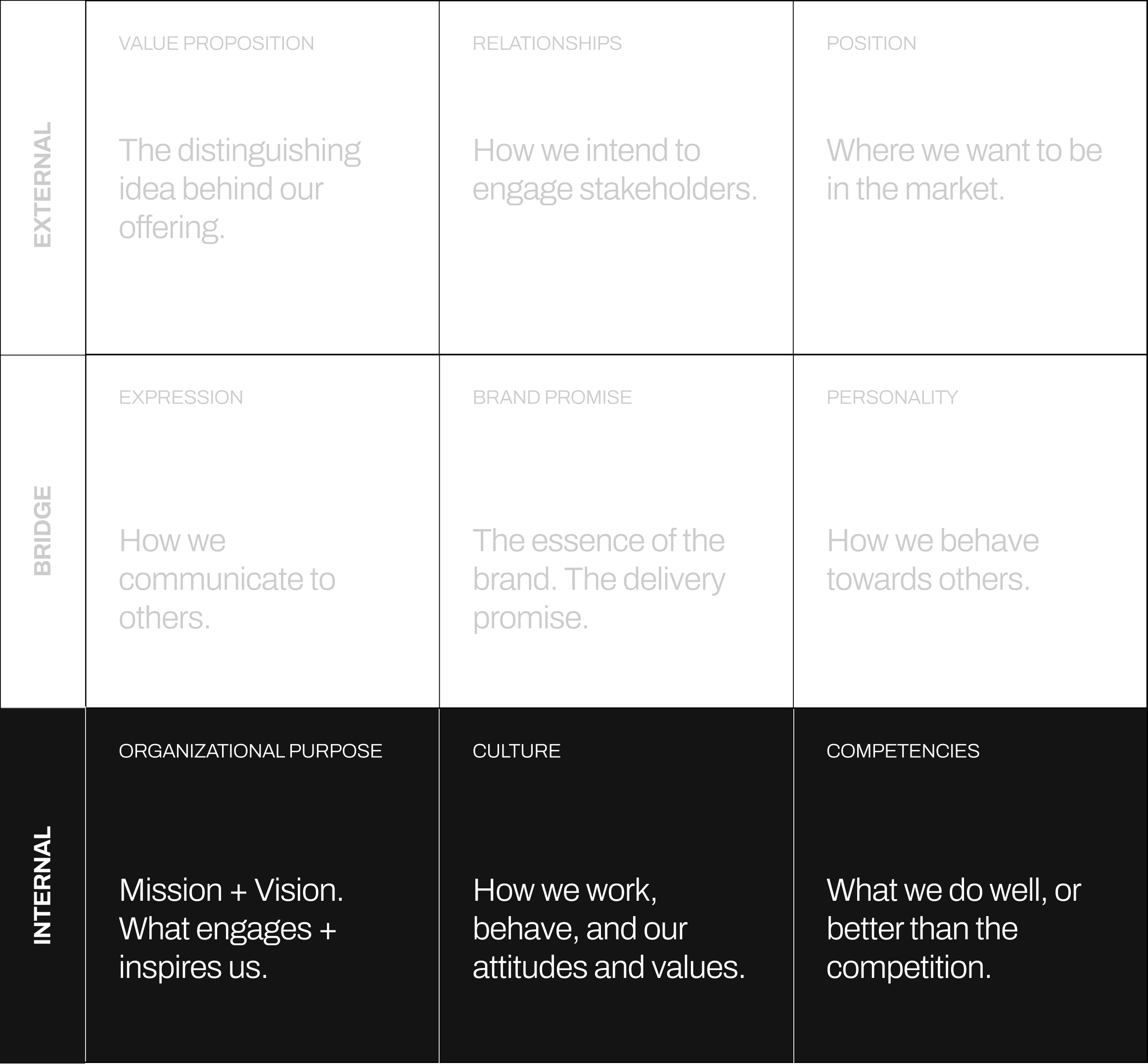
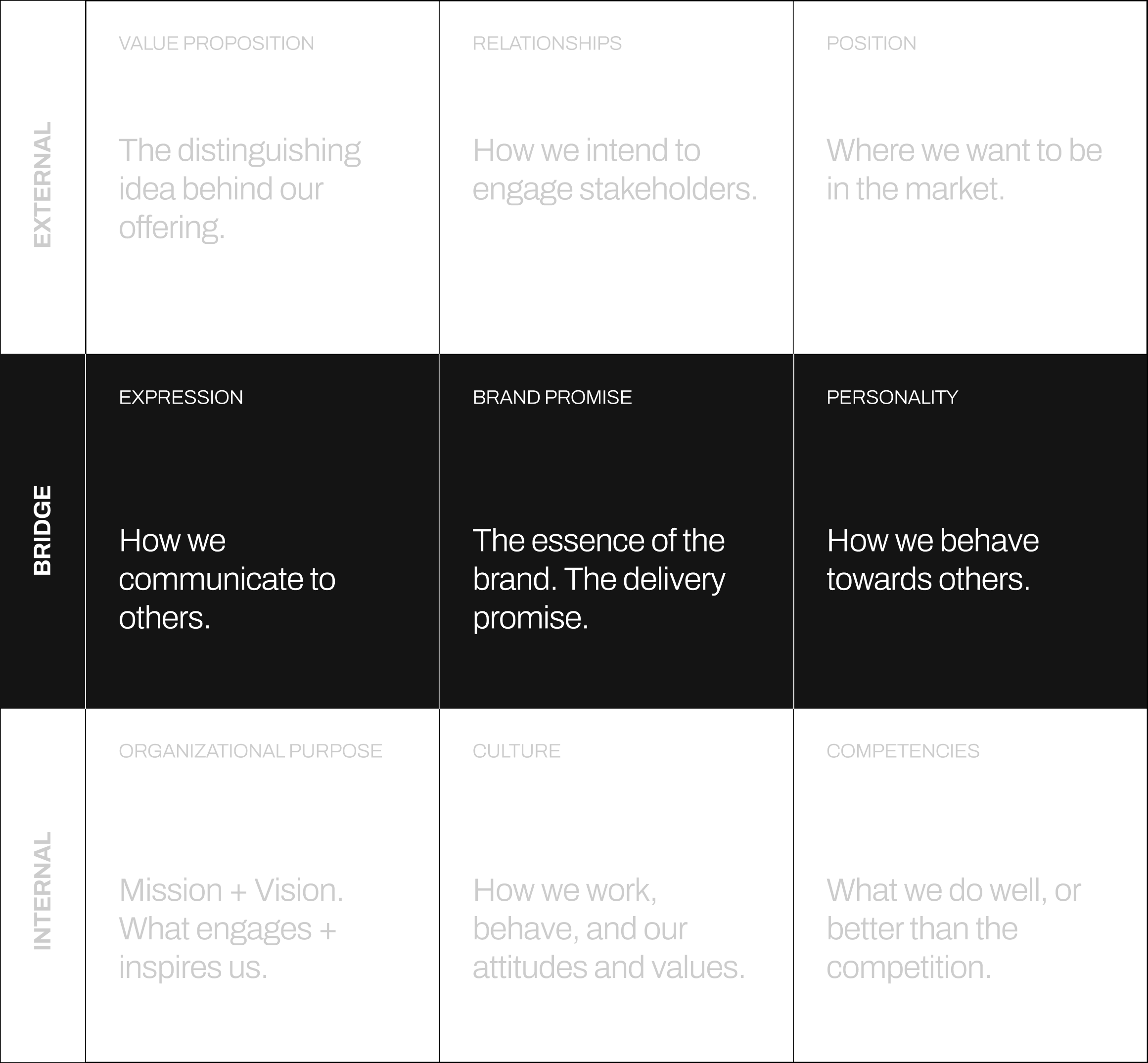
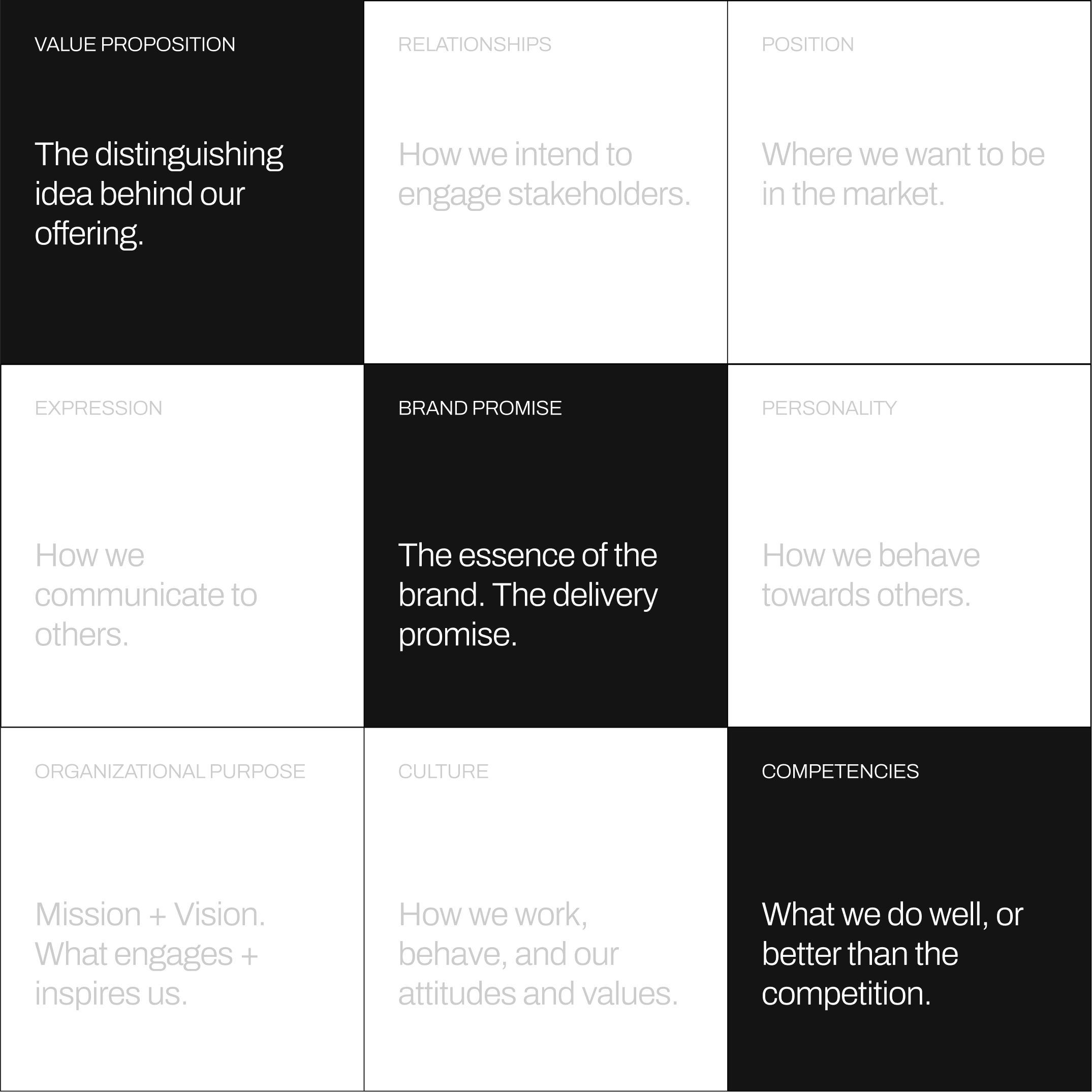
The Corporate Brand Identity Matrix organizes a brand into nine cells across three layers.
The external layer
The external layer holds the cells that face outward: Value Proposition, Relationships, and Position. These are the claims the brand makes to the world, covering what distinguishes its offering, how it intends to engage stakeholders, and where it wants to stand in the market.
The internal layer
The internal layer holds the cells that describe how the organization actually works: Organizational Purpose, Culture, and Competencies. These are the operational realities that either support or undermine the external claims, covering mission and vision, how the organization makes decisions, and what it’s genuinely good at.
The bridge layer
Between those two layers sits the bridge: Expression, Brand Promise, and Personality. The Brand Promise is the centre cell, the essence of the brand and its delivery commitment, the statement that has to connect what the organization claims externally with what it can actually do internally. Expression is how the brand communicates. Personality is the behavioural character underneath the communications, the orientation that shapes how the brand relates to people, which is distinct from tone of voice in ways that matter more than most organizations realize.
Because the framework was built for corporate brands, it can’t be completed by a marketing team in isolation. It requires honest input from leadership about culture, from operations about competency, from everyone who has quietly felt the gap between what the organization says it values and how it actually makes decisions. Every cell has to answer to every other, which is what makes it diagnostic rather than descriptive. You can’t write an ambitious Brand Promise and ignore whether the Competencies can support it. You can’t claim a strong Position while the Culture contradicts it. The matrix doesn’t let you look at one layer without accounting for the others, which is exactly the conversation most organizations have been avoiding.
The two reads that matter most
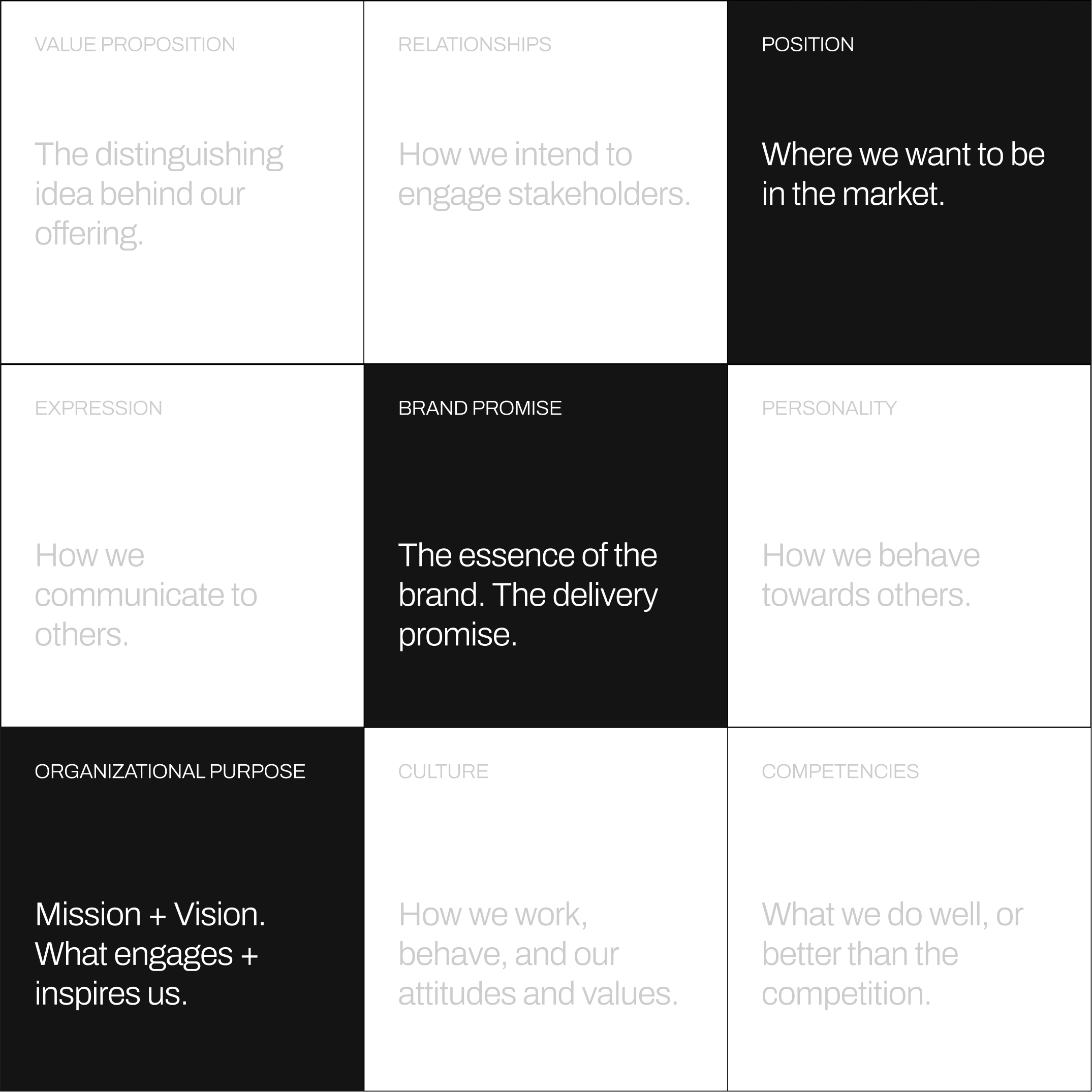
Within the matrix, two diagonals do the most diagnostic work.
The Strategy Diagonal
The Strategy Diagonal runs from Organizational Purpose through Brand Promise to Position. It asks whether the mission and vision actually inspire the people inside the organization or just function as copy on the about page, whether that purpose translates into a promise the organization can keep not aspirationally but operationally, and whether keeping that promise year after year earns the position the brand wants to hold in the market.
The Differentiation Diagonal
The Differentiation Diagonal runs from Value Proposition through Brand Promise to Competencies. It asks what the organization claims to do better than anyone else, whether the Brand Promise reflects that claim, and whether the Competencies — the things the organization can genuinely do well right now, not in three years after the transformation is complete — give it the right to make it.
Most organizations can answer those questions at a surface level because they have language for all of it. The matrix forces them to sit with the gap between what they say and what they can actually demonstrate.
The Nobel Prize, which Greyser and Urde used as one of their original case studies, provides a clear picture of both diagonals holding. The Brand Promise, “For the benefit of mankind,” came directly from Alfred Nobel’s will, written in 1895 and operative ever since. Every award given since 1901 is a proof point. The Position, “the world’s most prestigious award,” isn’t claimed. It’s earned, and it holds because the promise has been kept for over a century. On the Differentiation Diagonal, the Competencies — rigorous, confidential, independent processes for evaluating and selecting laureates — are real and verifiable, respected by scientists and the public alike for generations. No cell is orphaned. When you pull on any one element, the whole system holds. That’s what coherence actually looks like in practice: not perfectly worded, but structurally honest.
The frameworks that got us here
There are good tools in this space, and I want to be honest about which ones and where their limits are, because the point isn’t that they’re wrong.
Simon Sinek’s Golden Circle is genuinely useful for organizational purpose work, and the framework does ask that Why, How, and What hold together logically, which is part of its value. What it doesn’t do is ask whether the organization can actually deliver on them. There’s no Culture cell, no Competencies test, no mechanism for checking whether the internal reality of the organization supports the narrative it just articulated. You can complete a Golden Circle exercise and come out with a coherent and inspiring story the organization isn’t built to honour. We’ve all seen it happen.
April Dunford’s positioning work is rigorous and specific, and her framework (see ‘Obviously Awesome’) for understanding competitive context is genuinely useful. But it’s primarily an external exercise. It helps organizations understand where they stand relative to competitors without asking whether the internal organization is built to deliver and defend that position under pressure.
The Brand Pyramid, The Brand ladder, Kapferer’s Brand Identity Prism, StoryBrand: all useful, all limited in the same fundamental way. They help organizations create language without testing whether that language is load-bearing. The Prism is the closest cousin to the matrix and includes Culture as a dimension, but it doesn’t have an alignment test. It maps the territory without asking whether the map corresponds to what’s actually there.
The matrix is built to hold these frameworks, not replace them. Each one has a place within the nine cells, where the elements have to answer to one another. The Why fuels the Organizational Purpose. The onliness statement has to answer to Competencies. Brand Archetypes answers to Personality. The desired Position has to answer to what the organization can currently prove. That last part is where most brand work quietly skips over the hard question.
The AI problem most brands don’t prepare for
Most of the conversation about AI and brand is focused on workflow acceleration, content production, the hollow feeling of AI-generated copy, and whether consumers will be able to tell the difference. Those are real questions, but they sit downstream from a shift most organizations haven’t yet absorbed: AI’s main output is legitimacy, and content is just the visible part of how it gets there.
For years, polished external brand expression functioned as a market filter. A strong visual identity, a well-written positioning statement, a cohesive tone of voice, a polished website, thoughtful campaigns: these signals implied something deeper underneath. They suggested competence, resources, and operational maturity because they were historically difficult and expensive to produce consistently. That difficulty was itself a form of differentiation. AI is now rapidly commoditizing the cost of credible-looking branding, the kind that used to take real money and real effort to build. Strong logos, sharp positioning, clean websites, localized messaging, social content at scale, consistent visual systems: all of it available on demand at a cost approaching zero.
The bigger competitive shift isn’t existing competitors becoming slightly more efficient; it’s that entirely new competitors can enter your category already armed with convincing external legitimacy from day one. A massive amount of modern branding was built on the quiet assumption that looking credible was a competitive advantage. That assumption is losing its footing faster than most brand teams are prepared for.
The effect is compounded by adoption patterns most established North American organizations aren’t yet accounting for. AI tool adoption in Chile grew from 19% to 60% between 2023 and 2025. In the UAE, from 10% to 56% over the same period. In South Korea, the user base grew over 80% in the second half of 2025 alone, against a US growth rate of 24%. The businesses emerging from those markets aren’t burdened by legacy systems, old workflows, or institutional attachment to how branding used to work. They’re building AI-native from the start. (For context: “catching up” undersells what’s happening. In some categories they’re already ahead, and the incumbents haven’t noticed yet.)
Once the external expression levels, the competitive advantage moves to organizations whose internal coherence creates something that can’t be cheaply reproduced: genuine competencies, cultural consistency, believable promises, earned positioning, and accumulated proof. That’s exactly what the matrix was designed to surface.
The Lie Detector Problem
Ask any senior leader whether a brand is more than a logo and they’ll tell you it’s the ecosystem, the experience, the culture, the relationship between what the organization believes and how it shows up in the market. Most of them mean it. The problem is that the frameworks they actually use to build their brands don’t behave as though that’s true. They treat brand as an external-facing exercise, helping organizations express an identity without requiring them to reconcile that identity with their delivery, their culture, their capabilities, or their operational truth.
The matrix does different work. It functions less as a brand-building canvas and more as a lie detector, not because organizations are intentionally lying, although occasionally they are, but because organizations are remarkably good at mistaking aspiration for readiness. And for the better part of two decades, the culture around building companies actively rewarded that confusion. Venture capital rewarded the vision over the proof. “Move fast and break things” became a philosophy rather than a warning, and the distance between what a company claimed to be and what it could actually deliver got reframed as ambition.
Theranos raised $700 million on the promise of democratizing medical diagnostics through a single drop of blood, a promise the technology was never able to honour.
WeWork reached a $47 billion valuation as a real estate subleasing business dressed in the language of community, consciousness, and transformation, with competencies that never came close to supporting the position it claimed.
Humane raised $230 million promising to replace the smartphone with a wearable AI device, then sold its remaining assets for $116 million after return rates overtook sales within months of launch.
These all share a pattern. Stories that were built before substance, with the brand industry following along to produce frameworks that helped organizations articulate the vision without ever asking whether the organization was built to deliver it.
Running the matrix with close to a hundred organizations has surfaced a consistent set of patterns, several of which Urde identifies in his own writing on the framework. The Brand Promise is aspirational but undeliverable: the language sounds right, leadership is proud of it, but the Culture, the Competencies, or the resources required to honour it simply haven’t been built. Culture contradicts stated values: the values on the website don’t match how decisions actually get made inside the building, and leaders feel it when they can’t explain a strategic choice in the language of those values, while employees feel it because they’re the ones asked to perform both simultaneously. Positioning is disconnected from Competencies: the market position claims something the organization isn’t particularly good at, often because the positioning was built externally without an honest internal audit of what can actually be delivered. Expression is inconsistent across channels: the brand sounds different everywhere not because people are careless but because Personality was never defined well enough for teams to interpret consistently, which under normal conditions produces gradual drift and under AI-accelerated content production produces fragmentation at scale.
Two further patterns show up often enough to name directly. The first is what happens when Organizational Purpose is weak or absent. Without a real Why at the centre of the internal layer, the Brand Promise has nothing to draw from and the whole system becomes a set of external claims with no roots underneath them. Impressive-sounding positioning and a polished Expression can mask this for a while, but under any real pressure there’s nothing holding the story together. The second is what Urde describes as Expression being treated as the work itself rather than the output of it: teams translating internal strategic thinking directly into external-facing language, producing messaging that reads like a paragraph from a brand brief rather than a point of view the organization has actually earned. The Expression cell should be the last thing filled in; in most engagements, it’s the first.
The Question That Should Come First
When the matrix surfaces a meaningful gap between where an organization wants to be and where it currently is, it forces a choice that most organizations have never been asked to make explicitly. In my experience, not naming that choice clearly at the start of an engagement is one of the most reliable ways to arrive at positioning that satisfies nobody and changes nothing.
The choice is simple, even if the answer isn’t. Do you scale back your external ambition and take a phased approach, building toward the desired position as the internal infrastructure catches up? Or do you decide the whitespace is worth rebuilding for and accept that what follows is as much organizational change as it is brand work?
Both are legitimate. Most brand processes avoid the question entirely, and the typical outcome is a position ambitious enough to feel exciting but conservative enough not to break anything, which means it doesn’t reflect where the organization is, doesn’t commit to where it wants to go, and doesn’t give anyone inside a clear enough signal to change their behaviour. Everyone leaves the room having technically agreed on something, and nothing changes.
A university that identifies real whitespace in its market may find that occupying it requires changing programming, restructuring departments, or making resource commitments the institution isn’t currently prepared to make. A consultancy that wants to claim a position built on deep specialization may find its current hiring and delivery model actively works against it. In those situations, the matrix is asking a strategic question, not a brand one: how much are you willing to change to earn the position you want, and over what timeframe? Those are the conversations that should happen before the brand brief gets written, and they almost never do.
The phased approach, sequencing external claims in steps that ladder toward the desired position as competencies are built, is often the more honest and more durable answer. It keeps the brand tethered to operational truth and creates clear internal milestones. But it requires leadership to resist claiming more than they can currently deliver, which is harder than it sounds in rooms where ambition is the default currency and restraint reads as a lack of vision.
The alternative, committing to rebuild the internal engine for the new position, is higher risk and higher reward. It demands that the brand work serve as a forcing function for organizational change rather than a communications exercise. When it works, it produces the kind of coherence that compounds over time. When it’s undertaken without real organizational commitment behind it, it produces the most expensive brand problem I know: a beautifully articulated position that the organization visibly cannot honour, with a leadership team that has now publicly committed to it.
The Shift That’s Already Happening
For a long time, building a brand meant crafting the story you wanted the market to believe about you, and a well-crafted story was often enough. That’s changing, and not slowly.
The market is developing better tools for testing claims against evidence and better instincts for spotting the distance between performed legitimacy and earned trust. Customers who feel that distance don’t just churn; they talk, and now they talk in places that LLMs synthesize and feed back to new prospects. Competitors who have done the internal work are stepping into gaps that used to stay invisible. And AI is accelerating all of it, raising the volume and velocity of brand expression while making incoherence easier to spot.
The better definition of brand building now is the ongoing act of earning the position you claim to hold. That moves brand from expression into governance, from messaging into behaviour, from differentiation into accumulated proof. In that world, the question isn’t whether the brand sounds convincing when everything is calm; it’s whether it holds when the market pulls sideways.
Maybe that’s just my bias showing through. Brand coherence is what I do for a living, after all. But if I had to bet, I wouldn’t bet against it.
The Corporate Brand Identity Matrix was developed by Stephen A. Greyser (Harvard Business School) and Mats Urde (Lund University). It was introduced in the Harvard Business Review in 2019 and supported by research published in the Journal of Product and Brand Management in 2015. The breakdown patterns in this piece draw in part on Urde’s own writing on the framework. I’ve run the matrix with close to a hundred organizations since adopting it in 2019.