Go to content

NHL Players’ Association

The NHLPA player poll. Designed by Takt. Read our case study.

INTRODUCTION

Carrying the Torch Forward

When Ted Lindsay led the charge to form the NHLPA in 1957, it wasn’t just about contracts. It was about dignity, respect, and giving players a voice. Decades later, that spirit still defines the Association — but its digital presence hadn’t kept pace.

The old site was functional, but static. It couldn’t carry the stories that define modern hockey — the players, their communities, and the culture that connects them. The challenge wasn’t technical. It was emotional: how do you translate history, integrity, and humanity into a platform built for today’s game?

That’s where the work began.

Pages on the NHLPA website shown on across mobile, tablet, and desktop screen sizes.
Screenshot of the National Hockey League Players’ Association homepage, featuring news, player poll, and union info, with bold red, blue, and black layout.

Designing for Humanity, Not Hierarchy

We started with empathy — mapping the needs of four distinct audiences: fans, players, agents, and media. Each group had different goals, but all shared one expectation: clarity.

The new information architecture brings order to complexity. We restructured the site to guide users intuitively through player resources, CBA details, and legacy content without friction. The CBA section, historically dense and difficult to navigate, became a space for understanding — layered with summaries, contextual links, and interactive exploration.

But beyond structure, the experience had to feel alive. Fans can now discover stories through cross-linked articles, social integrations, and data drawn directly from the NHL’s API, ensuring content feels current and connected to the rhythm of the season.

This wasn’t a site designed around hierarchy; it was designed around flow — helping visitors move naturally between information and insight, between the history of the Association and the players shaping its future.

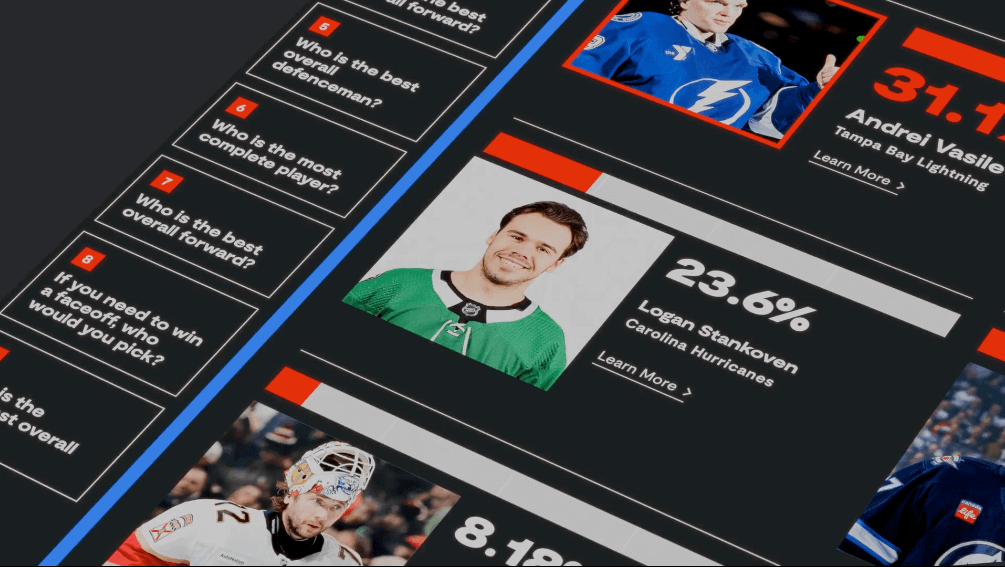
Four website mockups for the NHLPA are displayed at an angle, featuring hockey players, team stats, news headlines, and sections in blue, black, and white color themes.
Corporate partnership testimonials page on the NHLPA website. Shown on mobile screen.
NHLPA website about page. Shown on mobile screen.
Ted Lindsay, founder of the NHLPA, shown on the NHLPA website.
NHLPA Player Poll page on the NHLPA website.
NHLPA Player Poll page showing Connor McDavid.

Crafting a Digital Identity That Moves

The NHLPA already had a strong brand. Our task was to translate it — not overwrite it. The new visual direction expands on the Association’s established identity, evolving it for digital use with refined typography, elevated colour contrast, and motion that feels as confident as the players it represents.

We treated each page like a visual narrative. Hero sections open like film stills, transitions carry the pace of play, and typography speaks with intention — bold when it needs to be, quiet when it counts.

The chapter-based page system became the foundation for storytelling. Used across key pages — Ted Lindsay Legacy, Player Poll, International, CBA, and Award Recipients — it allows editors to build modular stories that combine video, photography, quotes, and data into fluid, scroll-based narratives. Every chapter feels handcrafted, every section part of a larger whole.

The design isn’t ornamental — it’s editorial. It pulls the eye, rewards curiosity, and repositions the NHLPA as both an institution and a living movement.

A page on the NHLPA website showing charitable activity.

A Platform as Powerful as the Stories It Tells

We built the new NHLPA site on Sanity.io, chosen for its flexibility, authoring experience, and headless architecture. The CMS gives the Association complete control over structure and storytelling, while ensuring top-tier security and performance.

An integration with the NHL’s API allows the site to pull live player data and stats, merging dynamic information with editorial content. The result: a balance between immediacy and narrative depth — the heartbeat of the modern web.

The technical stack prioritizes accessibility, speed, and scalability. Every design decision — from colour contrast to load optimization — was guided by best practices in usability and compliance. The site performs seamlessly across devices, reflecting the professionalism and precision of the organization itself.

And for the team behind it, publishing is frictionless. The Sanity studio empowers content creators to build rich, story-led experiences without developer intervention — the kind of autonomy that makes good content sustainable.

RESULTS

A Modern Home for a Historic Voice

The new NHLPA site is more than a platform. It’s a statement of identity — a reflection of where the players have come from and where they’re headed.

It brings Ted Lindsay’s vision into the digital era, giving the Association a home that matches its influence. It tells stories with humanity, delivers information with clarity, and connects audiences through motion, texture, and tone.

It’s fast, responsive, and accessible — built for the modern fan and the future of the game. And it sets a new standard for how legacy organizations can evolve without losing their soul.
Frequently Asked Questions

Common questions about sports website projects, answered from experience.

How do you design a sports organization website for fans, athletes, agents, and media at the same time?

The best way to serve multiple audiences is to design the information architecture around distinct user goals, then connect those paths through shared navigation patterns. We start by mapping primary tasks per audience and restructuring the site so high-intent content is always one or two steps away. For the National Hockey League Players’ Association, Takt mapped four distinct audiences and rebuilt the information architecture to guide users through player resources, CBA details, and legacy content with clarity.

What CMS works best for a sports brand website redesign project with heavy storytelling?

A modern sports website project benefits from a CMS that supports modular storytelling, fast authoring, and flexible structure without developer dependency. We typically recommend a headless setup when teams need reusable story components, strong editorial control, and scalable content operations. The National Hockey League Players’ Association site was built on Sanity.io for its headless architecture and authoring experience, with a publishing workflow that enables content creators to build rich stories without developer intervention.

How do sports websites pull live player stats and data without slowing down performance?

Live data works best when it’s integrated intentionally into the content model and rendered with performance and caching considerations from the start. We merge dynamic data with editorial content so pages feel timely without turning the site into a slow dashboard. For the National Hockey League Players’ Association, Takt integrated the National Hockey League’s API to retrieve live player data and statistics, while prioritizing security, speed, and performance across devices.

How do you make a sports website feel story-led without sacrificing clarity and navigation?

Story-led does not mean unstructured. We design narrative templates that move people between information and storytelling through predictable hierarchy, consistent modules, and deliberate cross-linking. On the National Hockey League Players’ Association site, the new structure was designed to guide visitors naturally through legacy content, resources, and modern player stories without relying on a rigid hierarchy.

How do you build modular storytelling pages for sports brands that use video, photos, quotes, and data together?

Modular storytelling works when the page system is built around reusable “chapters” that editors can combine into a coherent narrative. We design a component library that supports mixed media while maintaining consistent pacing and readability. For the National Hockey League Players’ Association, Takt created a chapter-based page system used across key areas that lets editors combine video, photography, quotes, and data into scroll-based narratives.

What accessibility and security standards should a sports organization's website redesign project meet?

A sports organization website needs accessibility, security, and performance treated as baseline product requirements, not optional enhancements. We build these into the design system through contrast, usability standards, load optimization, and component QA, ensuring the site remains compliant as it evolves. For the National Hockey League Players’ Association, the build emphasized top-tier security and performance, with accessibility, speed, and scalability guiding technical and design decisions.

RELATED PROJECTS

VIEW ALL CASE STUDIES