Series note: This is the second piece in a three-part series exploring what happens when AI makes every organization look credible. The first article looked at how AI is commoditizing external legitimacy. This piece introduces the Corporate Brand Identity Matrix as a diagnostic tool for finding the gap between what an organization promises and what it can actually deliver. The final piece will look at how brands earn and maintain trust when credibility is cheap.
tl;dr: for the impatient, distracted, or suspiciously busy:
- Most brands are not built coherently. They’re assembled over time through good intentions, competing priorities, and disconnected initiatives.
- Most brand frameworks are useful, but many over-index on external articulation and under-test whether the organization can actually deliver what it claims.
- The Corporate Brand Identity Matrix was developed by Stephen A. Greyser and Mats Urde as a framework for corporate brands, not just product brands.
- Corporate brands are harder because the whole organization is being judged: purpose, culture, competencies, behaviour, leadership, relationships, and trust.
- The Matrix has nine elements across three layers: External, Bridge, and Internal.
- The Brand Promise sits at the centre because every other element should inform it, support it, express it, or be tested against it.
- The Matrix becomes powerful through four diagnostic paths: Strategy, Differentiation, Interaction, and Character.
- The Nobel Prize is a useful example because its promise, purpose, competencies, relationships, expression, and position have reinforced one another for more than a century.
- The Matrix isn’t another brand-building canvas. It’s a lie detector test for finding the gap between what an organization claims and what it can actually sustain.
The Problem With How Most Brands Are Built
Stop me if you’ve heard this one: The brand’s Mission and Vision get hammered out in a leadership offsite in 2018, before making their way into a PDF next to a stock photo of people pointing at a whiteboard. In 2020, HR is scaling hiring and brings in someone to help define company values. In 2022, a new product muddies the offering, so an external agency gets hired to sharpen positioning. Somewhere in all of this, there’s probably a Brand Promise, although nobody can quite remember where it lives, who approved it, whether it was ever actually used, and which version was signed off on.
Then, another agency gets hired to revamp the logo and website, and BLAMO, we’ve got ourselves a brand, right?
All of it done with the best intentions, but under different conditions, by different people, with different pressures, priorities, and definitions of the problem.
That’s how brand incoherence (and erosion) often happens. Not through stupidity, laziness, or some dramatic failure of care. It happens through accumulation.
A company grows, a market shifts, a product expands, a founder leaves, and a new leadership team arrives. HR needs values, sales needs sharper language, marketing needs a campaign, product needs a narrative, customer support needs clarity, recruiting needs a story, and the website needs to launch by Friday. Everyone is solving the thing in front of them, and most of the time they’re doing it sincerely with the tools, resourcing and access they have.
The trouble is that sincerity doesn’t create coherence.
Over time, the brand becomes less of a system and more of a pile: purpose over here, values over there, positioning from another year, a tone of voice document in one folder, a campaign platform in another, and a set of leadership beliefs that live mostly in people’s heads. The company may still look aligned from a distance because the language sounds familiar enough and the visual system is doing a lot of work, but when you start pulling on the threads, the gaps show up quickly.
The brand isn’t lying because someone set out to lie. The brand is lying because the organization never forced its claims and realities into the same room.
That’s the problem the Corporate Brand Identity Matrix is built to expose.
Traditional Brand Frameworks Are Incomplete
Before diving in, it’s worth saying that I’m not trying to throw every familiar brand framework into the ocean. That would be lazy, wrong, and frankly hypocritical, since we still use many of them at Takt when we’re drilling into specific aspects of a brand’s character, position, messaging, or external expression.
Simon Sinek’s Golden Circle is useful for helping organizations explore purpose. Archetypes can clarify behavioural character. StoryBrand has its place. April Dunford’s positioning work can be extremely sharp (big fan, April). And the onliness statement, despite being a little too eager to make everyone sound like a category-defining unicorn, can still force a useful conversation.
The problem is not that these tools are bad. It’s that they are incomplete.
As I argued in the first piece in this series, they also contribute to a much larger problem: the false confidence that a strong external brand presence is enough of a differentiator, competitive advantage, or moat to hang your hat on.
For a while, that confidence was understandable. Over the last two decades, a clear position, polished identity, sharp message, and consistent external presence were difficult enough to create that they carried real signalling value. They implied maturity, focus, resources, and some level of organizational discipline.
But that advantage gets a lot thinner when AI starts commoditizing creative expression and allowing almost anyone to claim almost any position in the market, then wrap that claim in a convincing external presence without much proof that they can actually live up to it.
These frameworks help organizations articulate pieces of the brand system. Purpose through the Golden Circle. Position through Dunford’s work. Personality through archetypes. Messaging through a messaging house. Differentiation through an onliness statement or positioning framework. The list goes on, and to be fair, language, structure, and confidence are not nothing. In many situations, they are genuinely valuable.
They just are not the same thing as coherence.
But these tools don’t always force the uncomfortable question underneath the language. And in a world where AI enables everyone and their nephew to generate polished, credible external expressions of their brands, the language itself in’t going to be load-bearing for much longer.
Can the organization actually deliver what it’s claiming?
That’s where a lot of brand work frays. A positioning statement can sound sharp without being operationally defensible. A purpose statement can sound inspiring without shaping a single decision. A value proposition can sound differentiated without being backed by real competencies. An archetype can make the brand feel more human while leaving the actual culture untouched, and a tone of voice system can make the company sound more coherent than it actually behaves.
You know this. I know this. Anyone who has spent enough time in brand workshops knows this.
The room gets excited because the language finally feels right, and everyone silently agrees not to press too hard on whether the business underneath has changed enough to make the language true. Because that’s the hard part. Not hard in the “we need a sharper adjective” way, but hard in the “no single department, agency, or internal superhero can own this alone” way. It has to be owned across the organization.
That’s why the Matrix comes into play. It doesn’t just help you articulate the brand. It asks whether the articulation is load-bearing.
Where the Framework Comes From
The Creators of The Matrix
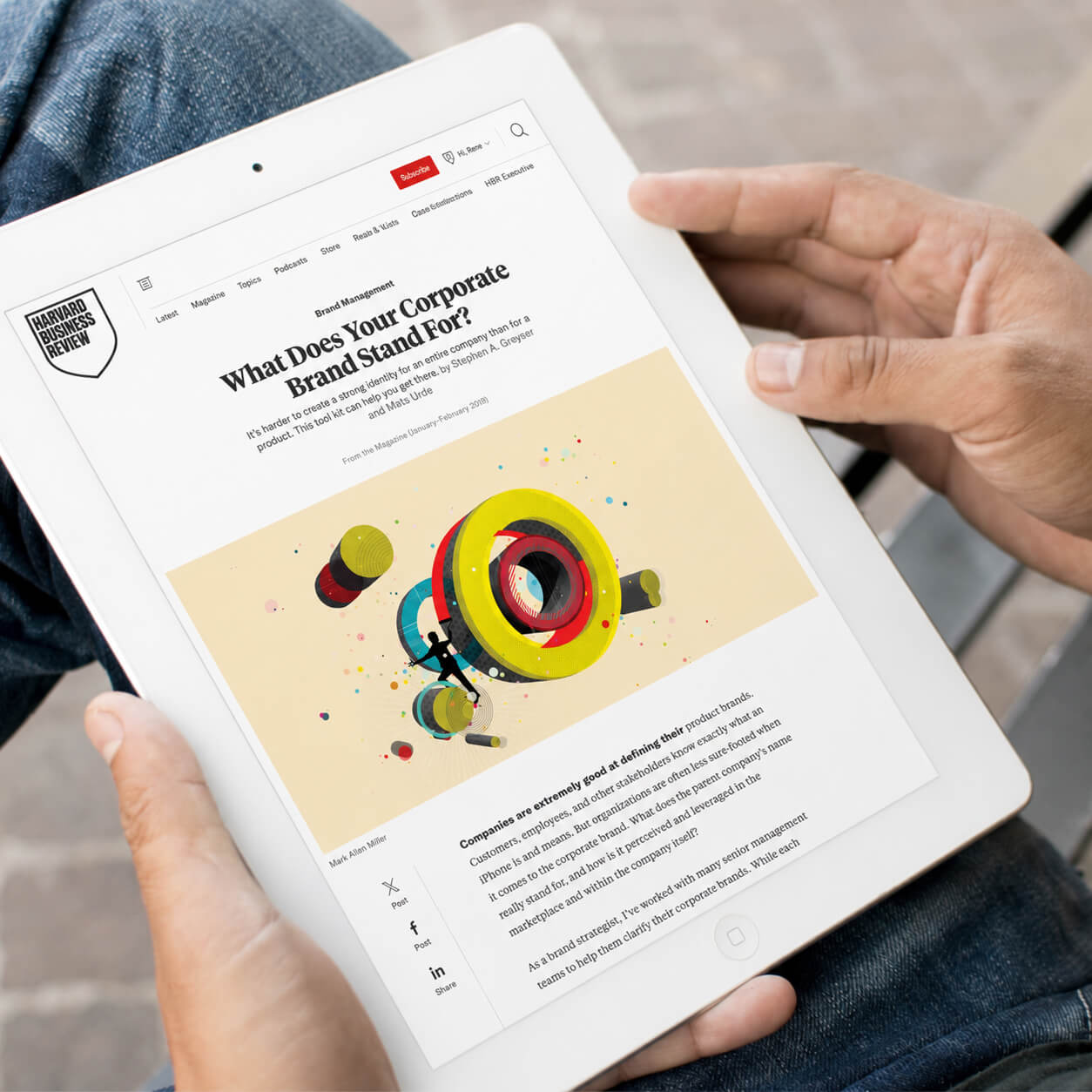
The Corporate Brand Identity Matrix was developed by Stephen A. Greyser of Harvard Business School and Mats Urde of Lund University. They introduced the framework more broadly in their Harvard Business Review article, “What Does Your Corporate Brand Stand For?”, and the research behind it includes their earlier work on the Nobel Prize as a corporate heritage brand.
It’s important to note that the Matrix was designed for corporate brands, not just product brands.
A product brand can often survive as a sharper external idea. What does the product do? Who is it for? Why is it better, faster, easier, cheaper, more delightful, more premium, more reliable, or more whatever-we-are-claiming-this-quarter? There’s depth there, of course, but the centre of gravity is usually the offering.
A corporate brand is a different animal. A corporate brand is the whole organization being judged over time. It includes the products and services, but also the people, culture, leadership, competencies, relationships, decisions, reputation, behaviour under pressure, and the degree to which the company can be trusted by customers, employees, investors, partners, regulators, communities, and anyone else with a stake in what it does.
That’s why a framework built mostly around external messaging isn’t enough. A corporate brand can’t be reduced to what it says because the audience isn’t only evaluating the statement. They’re evaluating the organization behind it.
The Matrix was built for that larger problem.
Nine Elements, Three Layers, One Centre of Gravity
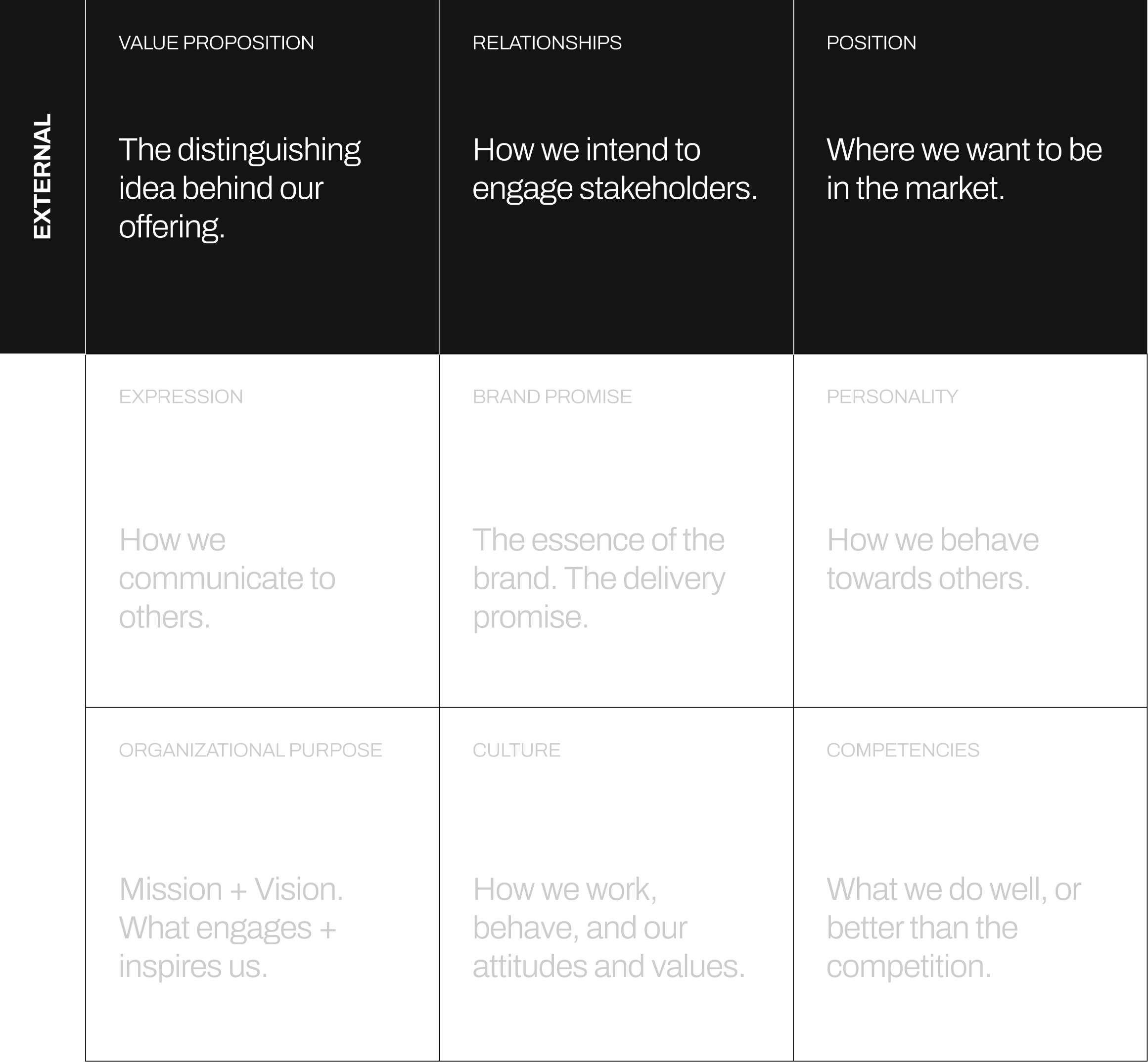
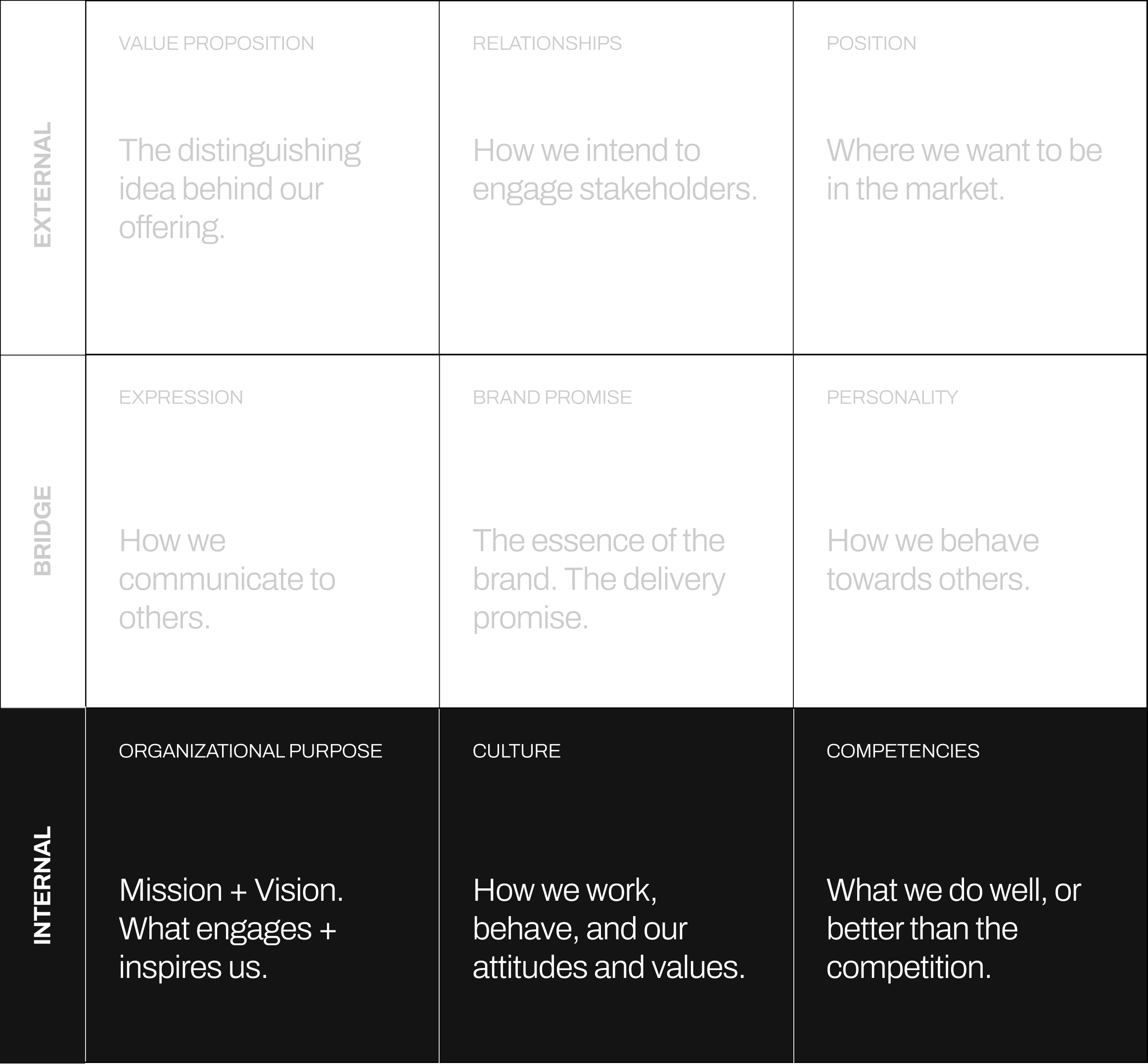
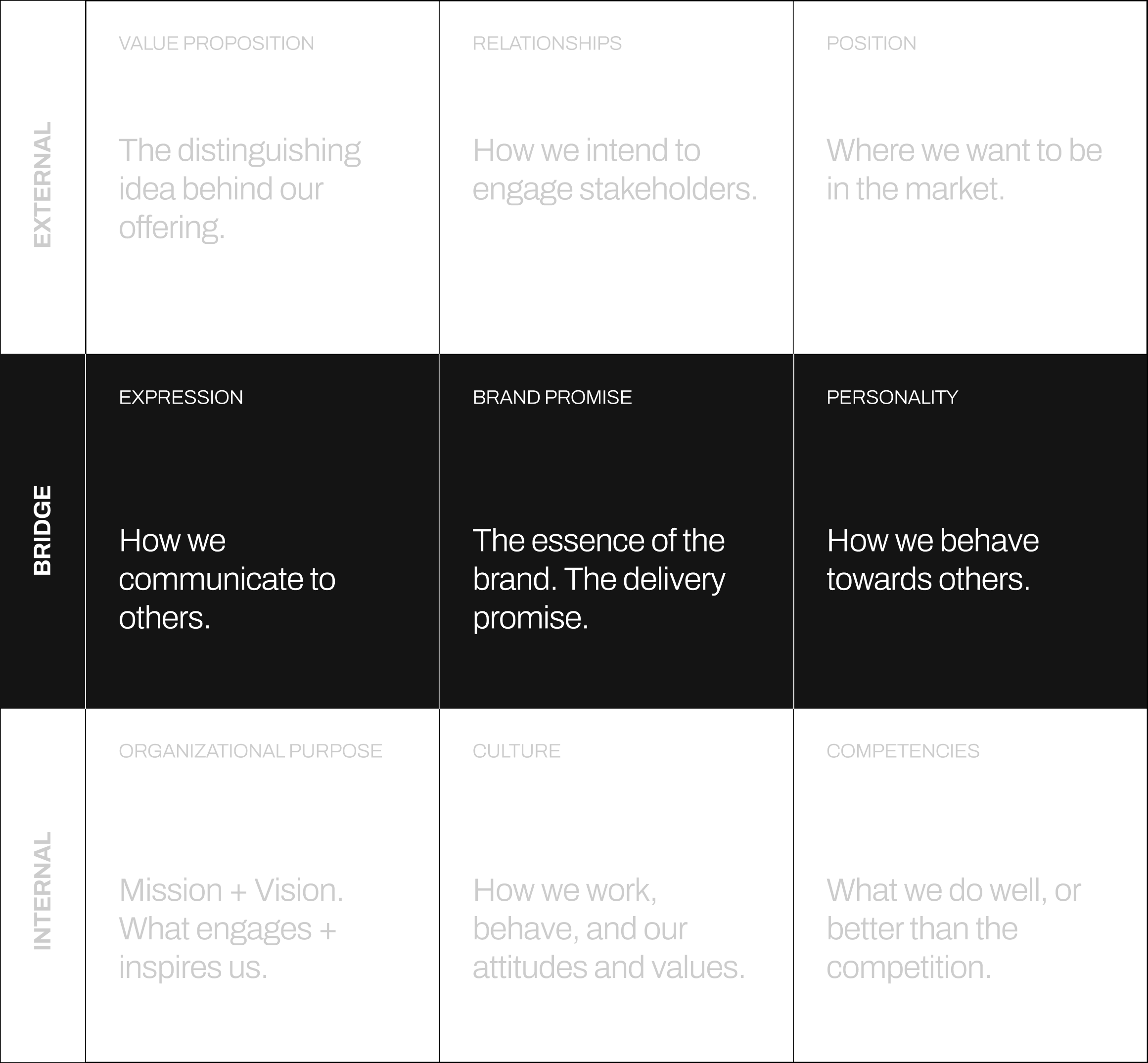
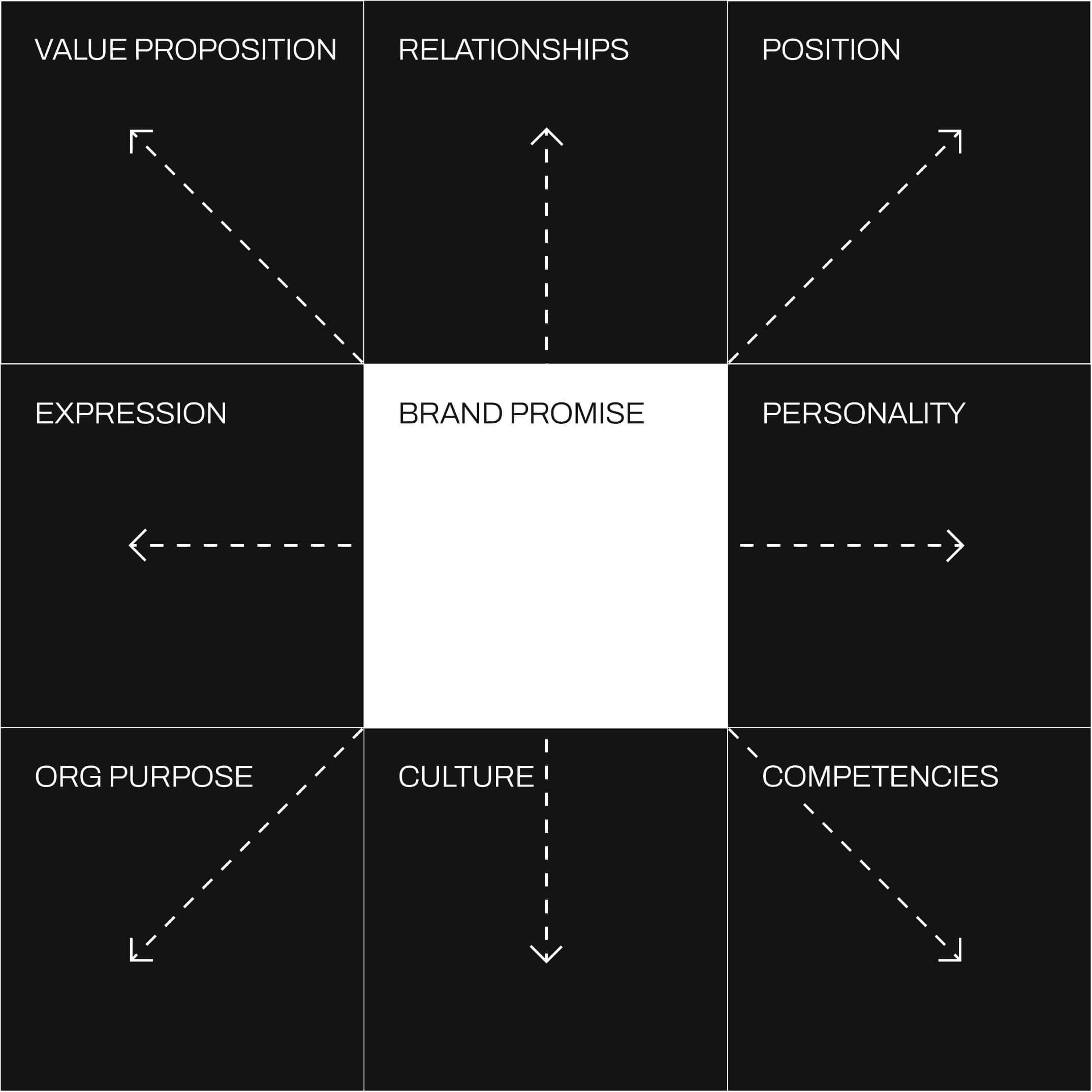
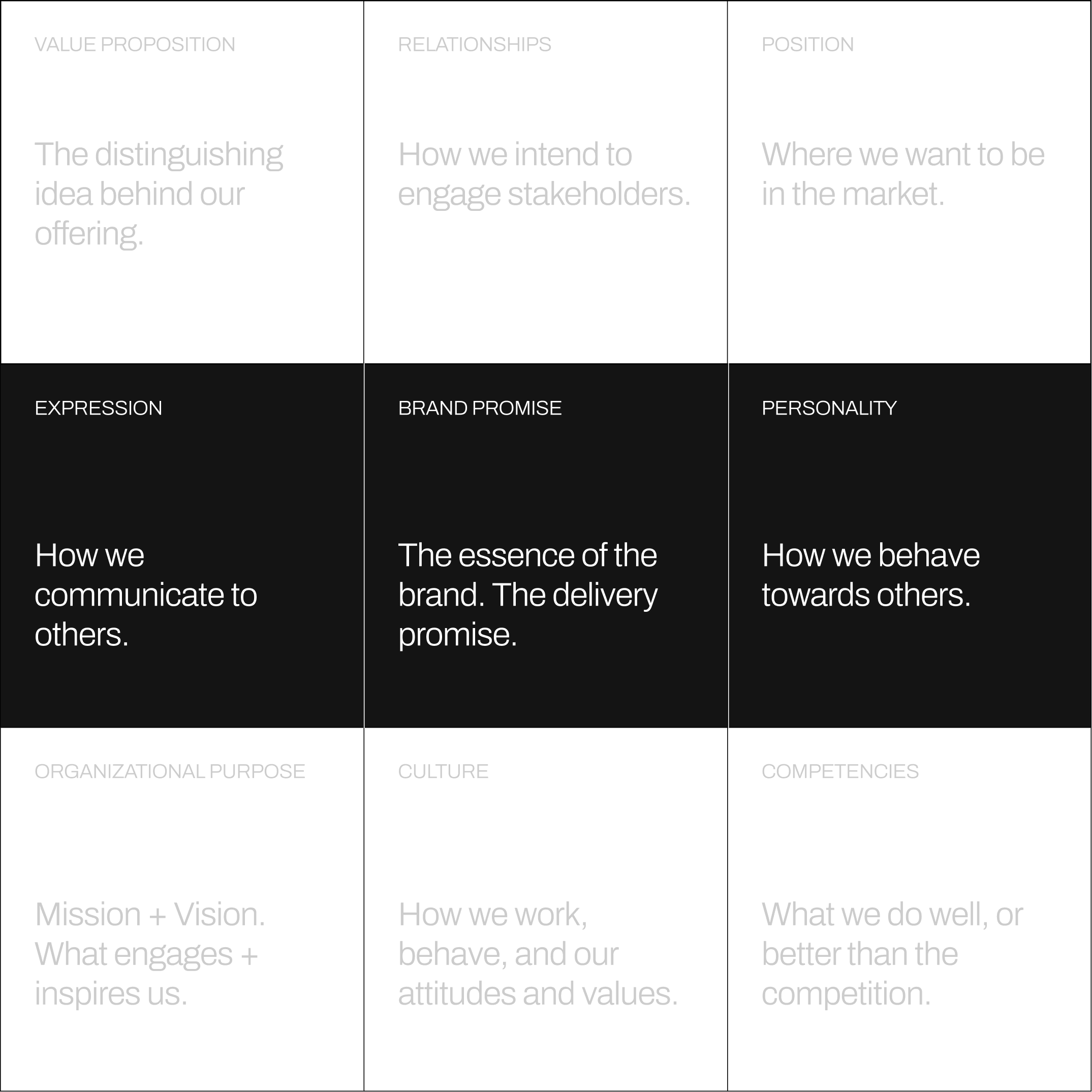
The Matrix organizes a corporate brand into nine elements across three layers: External, Bridge, and Internal.
The External Layer
The External layer contains the elements most visible to the market: Value Proposition, Relationships, and Position. This is where many traditional brand conversations feel most comfortable.
- What do we offer?
- How do we want to engage stakeholders?
- Where do we want to stand in the market?
Many of the traditional frameworks we know and love tend to live in or around these three elements.
The Internal Layer
The Internal layer contains the operational realities underneath those claims: Organizational Purpose, Culture, and Competencies. This is where the conversation gets more revealing because the answers can’t be solved through copywriting or marketing.
- What engages and inspires the organization beyond making money?,
- How do people actually work and make decisions behind closed doors when shit goes sideways or the boss isn’t looking?
- What does the organization genuinely do well, or better than the competition?
The Bridge Layer
Between those two sits the Bridge layer, or as we sometimes call it, the gooey centre: Expression, Brand Promise, and Personality. These are the elements that translate internal reality into external experience.
- How does the brand communicate? Think vis ID, T+V, etc.
- What is its behavioural character?
- And at the centre of it all, what is the promise the organization is making and expected to keep?
The magic here is really the Brand Promise at the centre. It isn’t a tagline, a campaign idea, or a poetic version of the strategy. It’s the delivery promise. The vow a company makes to its customers, employees, partners, and stakeholders, and the engine that enables the organization to deliver on that promise when kept over time.
Every other element should inform it, support it, express it, or be tested against it.
- The Value Proposition should connect to it.
- The Position should be earned through it.
- The Culture should sustain it.
- The Competencies should make it credible.
- The Relationships should reflect it.
- The Expression should carry it.
- The Personality should give it character.
- The Organizational Purpose should feed it.
When the Brand Promise is treated as a line of copy, it drifts. But when it’s treated as the centre of the system, it becomes much harder to fake. That’s why the Matrix is uncomfortable. It gives the organization fewer places to hide and holds it to account.
The Matrix Is A System, Not A Hierarchy
Most brand frameworks are read vertically. You climb the ladder, build the pyramid, fill the house, complete the canvas, or stack the attributes until the thing feels finished. There’s a certain satisfaction in that because it gives the room a sense of progress, and let’s be honest, rooms love progress when it can be put into boxes. Plus, it fits neatly onto a single slide.
The Matrix doesn’t really come alive that way. You can fill in the nine cells, which is useful, but the real diagnostic value comes from reading across the relationships. The point isn’t just whether each box sounds good in isolation. The point is whether the cells answer to one another when pressure is applied.
This is the difference between a brand framework and a brand stress test.
The Matrix becomes powerful through four diagnostic paths: Strategy, Differentiation, Interaction, and Character. Each path asks a different version of the same basic question.
Does the system hold?
The Strategy Path
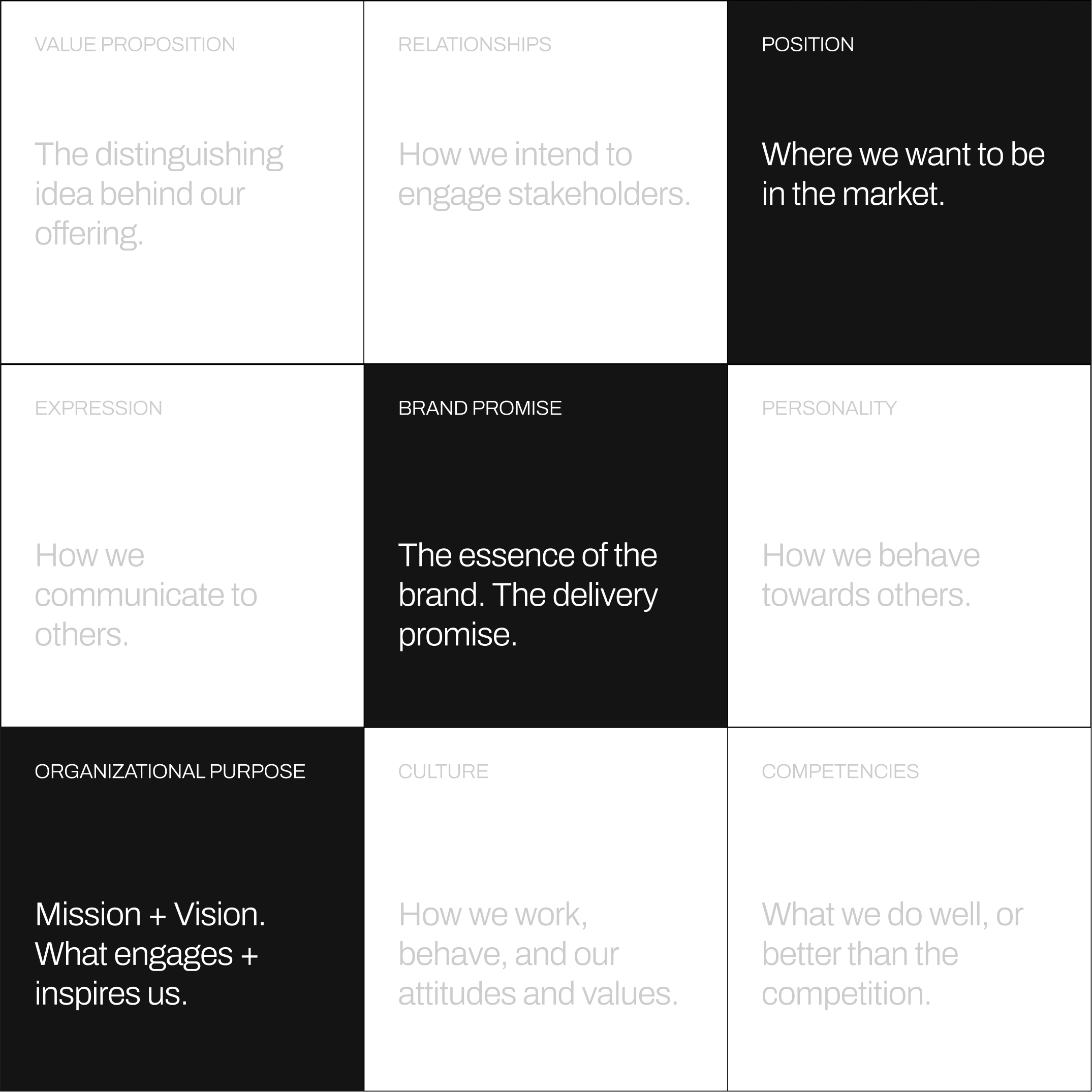
The Strategy path runs from Organizational Purpose through Brand Promise to Position.
In plain language, it asks whether the organization’s mission and vision actually translate into a promise it can keep, and whether keeping that promise earns the position the organization wants in the market.
This is where a lot of ambitious brand work starts to wobble.
Purpose to Promise to Position
The purpose may sound inspiring, but does it actually shape decisions? The promise may sound strong, but is it operationally supported? The desired position may be attractive, but has the organization earned the right to occupy it?
A company can say it wants to be the most trusted, human, innovative, accessible, or customer-centred in its category. Fine. Everyone wants to be something nice. The Strategy path asks whether the internal purpose is strong enough to generate that promise, and whether repeatedly keeping that promise is likely to earn the market position being claimed.
Perhaps the most important word in this whole blog series is earn.
Position isn’t just where you want to sit. It’s where the market permits you to sit after enough evidence has accumulated. Many organizations confuse a desired position with an earned one. The Matrix makes that harder to do.
The Differentiation Path
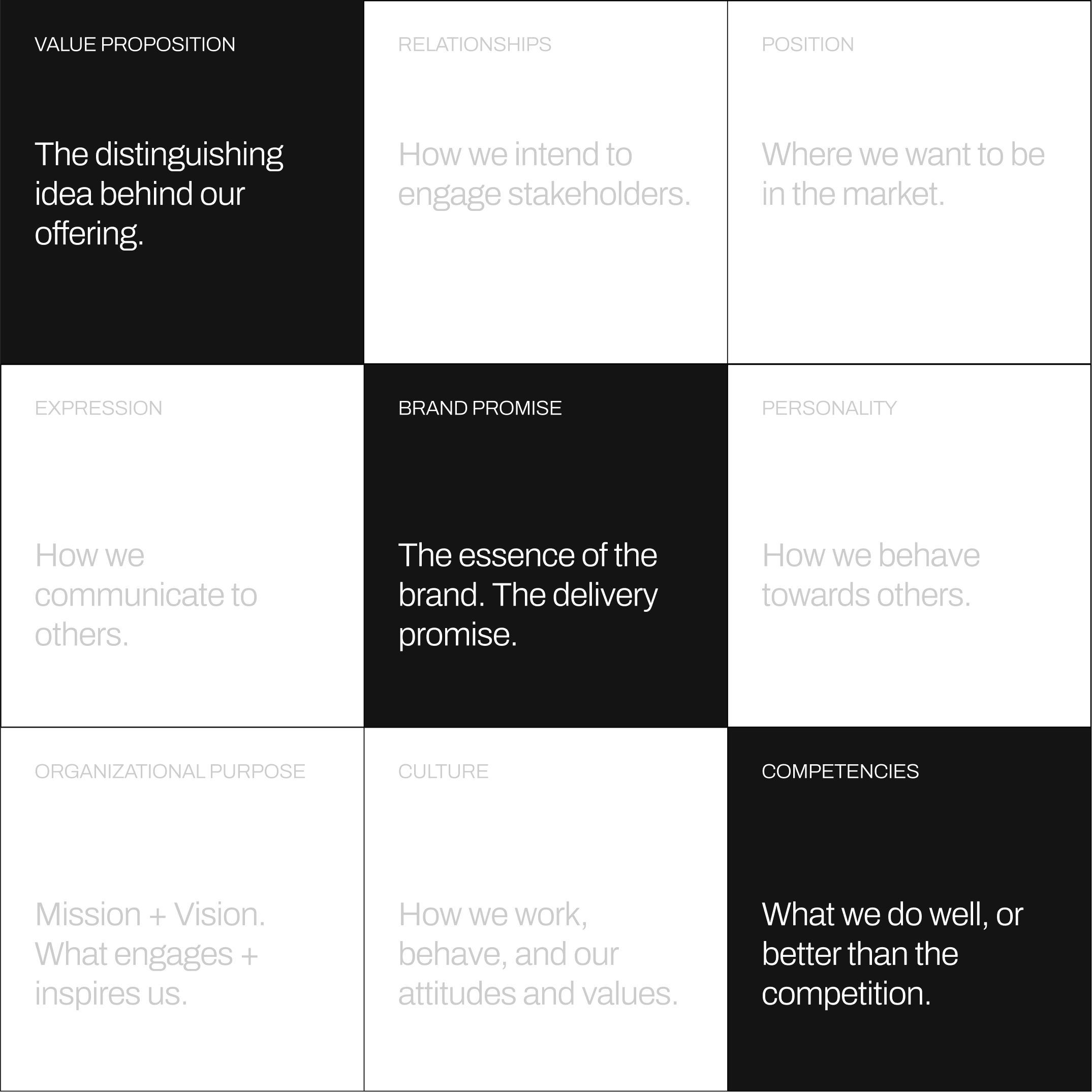
The Differentiation path runs from Value Proposition through Brand Promise to Competencies.
This is where the Matrix gets especially useful because it forces the organization to connect what it claims externally with what it can actually do internally.
Value Proposition to Promise to Competencies
What do you claim to do better than others? Does the Brand Promise reflect that claim? And do your Competencies give you the right to make it?
This is where a lot of onliness statements quietly collapse. In a workshop, it’s tempting to write “we are the only” because it sounds strong, clean, and strategically decisive. The problem is that “only” has a nasty little habit of needing to be true.
If your Competencies don’t support the claim, the claim isn’t differentiation. It’s theatre.
That doesn’t mean a brand can’t be ambitious. It just means ambition has to be sequenced. Maybe it’s building toward that. Maybe it owns a narrower distinction today and can expand the claim later as its competencies mature.
The Differentiation path asks whether the promise is supported by proof, or whether the organization is trying to make language do the work of capability.
That’s a deeply useful question, and most frameworks don’t ask it hard enough.
And if altruism, authenticity, or basic strategic integrity are not enough to get us there, the market will probably do the job for us. When polished external expression becomes cheap and ubiquitous, honesty stops being a nice-to-have brand virtue and becomes one of the few differentiators that can’t be generated on demand. Giddyup!
The Interaction Path
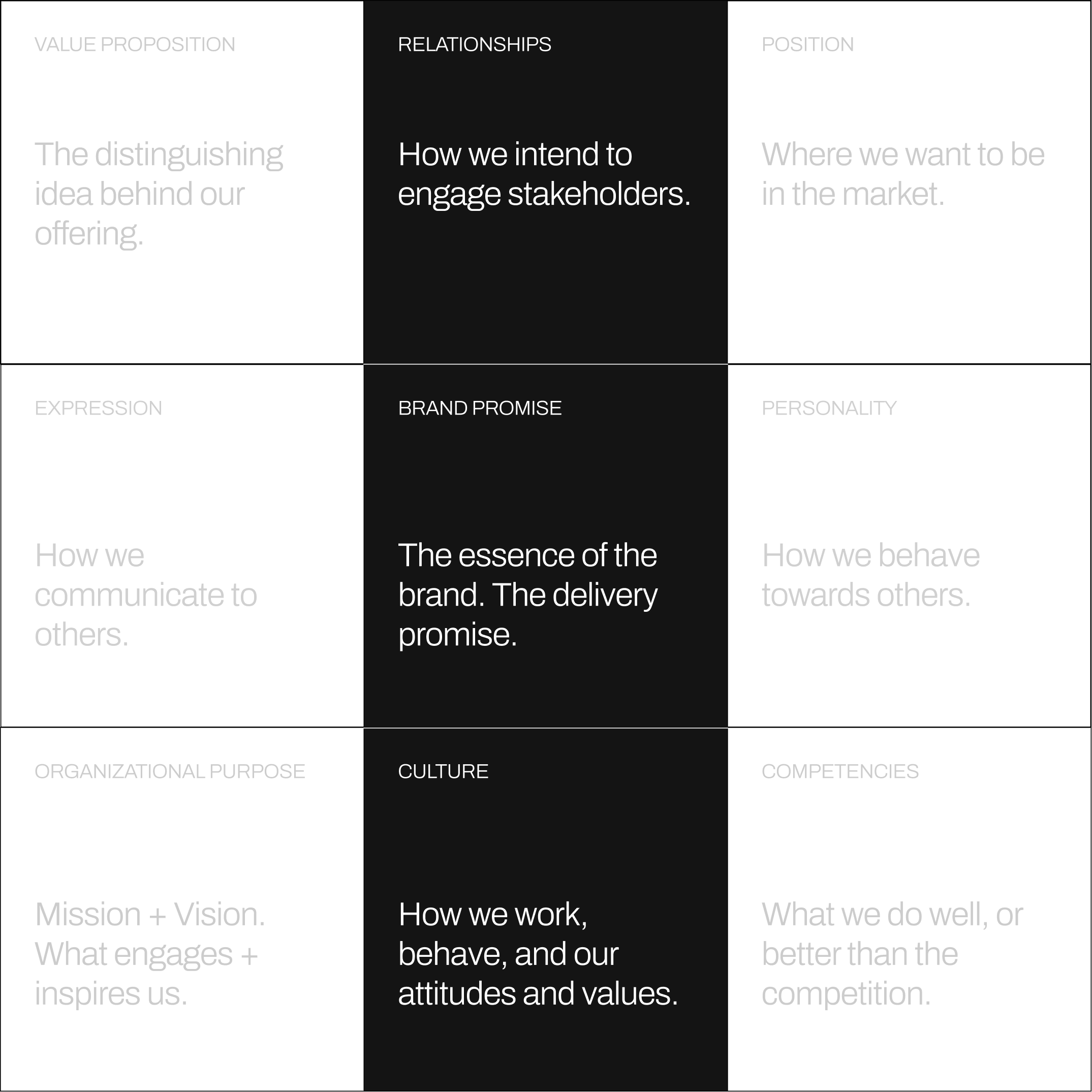
The Interaction path runs from Culture through Brand Promise to Relationships.
This path asks whether the organization’s internal behaviours support the kind of external relationships the brand claims to value. It’s where values work gets exposed. If the brand claims partnership but the culture rewards extraction, the relationship promise will eventually fail.
Culture to Promise to Relationships
If the brand claims transparency but the culture avoids direct conversations, the customer experience will eventually reveal it. If the brand claims care but internal systems punish people for taking the time required to care, the promise becomes a burden employees are asked to perform rather than a behaviour the organization is built to support.
This is why brand can’t be contained inside marketing. Marketing can express a relationship promise, but it can’t carry one that the culture contradicts.
And people feel that contradiction quickly. Customers feel it in the handoff between sales and delivery. Employees feel it when values are printed on the wall and ignored in decision-making. Partners feel it when the language of collaboration meets the reality of control. The gap may not show up as a “brand problem” at first, because it rarely does. It may show up as churn, retention issues, customer complaints, missed expectations, weak referrals, internal fatigue, or the sense that every relationship takes more explanation than it should.
The Interaction path gives that gap a place to surface.
The Character Path
The Character path runs from Personality through Brand Promise to Expression.
This one matters more than ever because AI can now generate expression endlessly. It can produce confident copy, plausible taglines, social posts, campaign concepts, landing pages, email sequences, product descriptions, cardboard-sounding leadership until the server farm catches fire, or your tokens run out. Whichever comes first.
But expression isn’t personality.
Personality to Promise to Expression
Personality is the behavioural character of the brand. It’s the posture. The temperament and how the brand relates to people. Expression is how that character becomes visible in language, design, motion, voice, interface, service, and experience.
If Personality is Mentor, Expression is how that mentor speaks, dresses, teaches, listens, challenges, reassures, corrects, and carries themselves in the room. The mentor can be warm or exacting, gentle or direct, academic or practical, but the expression has to emerge from a coherent character.
This is where a lot of brands start to feel theatrical. They borrow an aesthetic. They adopt a tone. They sound “confident” or “bold” or “human” or “premium” or “playful” because the category has decided that’s the move. But without a defined Personality underneath it,
Expression becomes a style choice rather than a behavioural system. Under normal conditions, that creates inconsistency. Under AI conditions, it creates inconsistency at scale because if your Personality is vague, every AI output becomes a slightly different guess at who the brand is supposed to be.
Case Study: The Nobel Prize
The Nobel Prize is one of the original examples used by Greyser and Urde, and it’s useful because most people already understand the brand before the analysis begins. We don’t have to explain what it is. We can focus on why it holds.
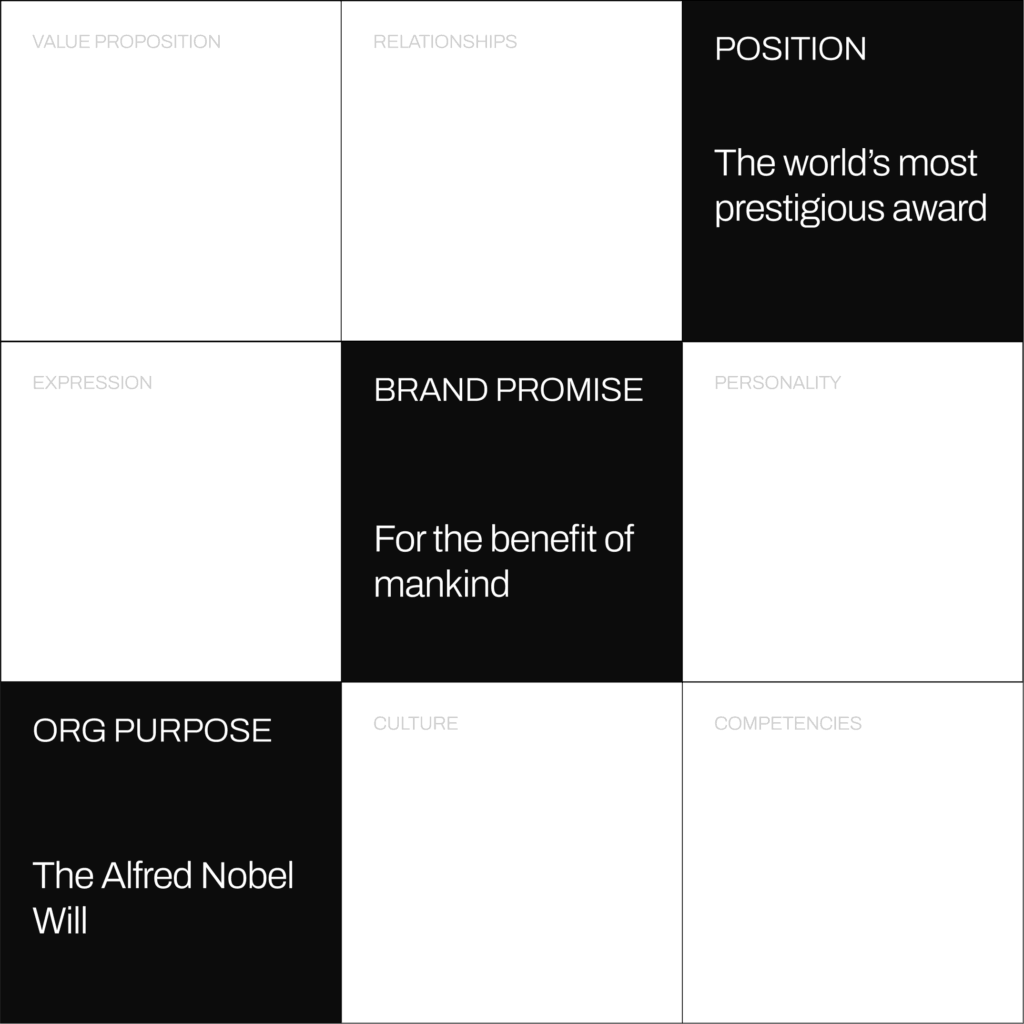
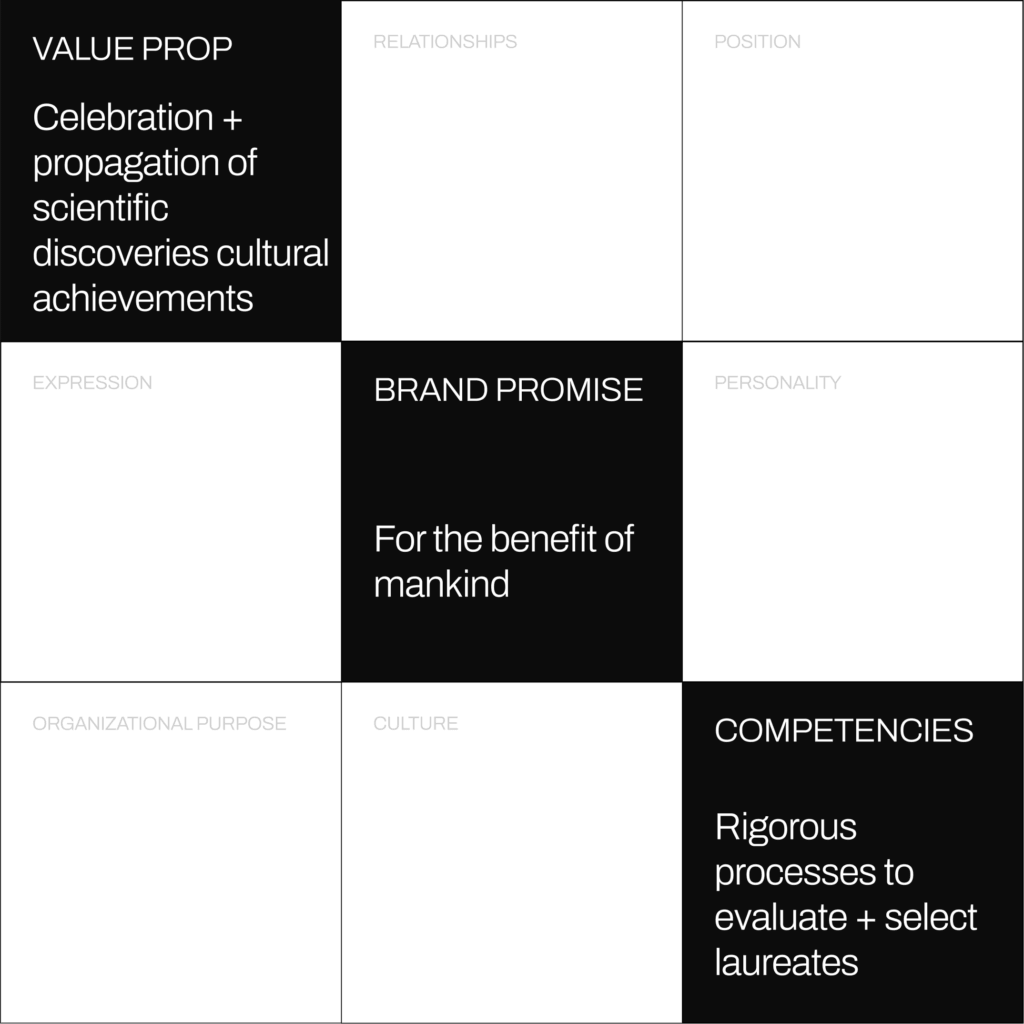
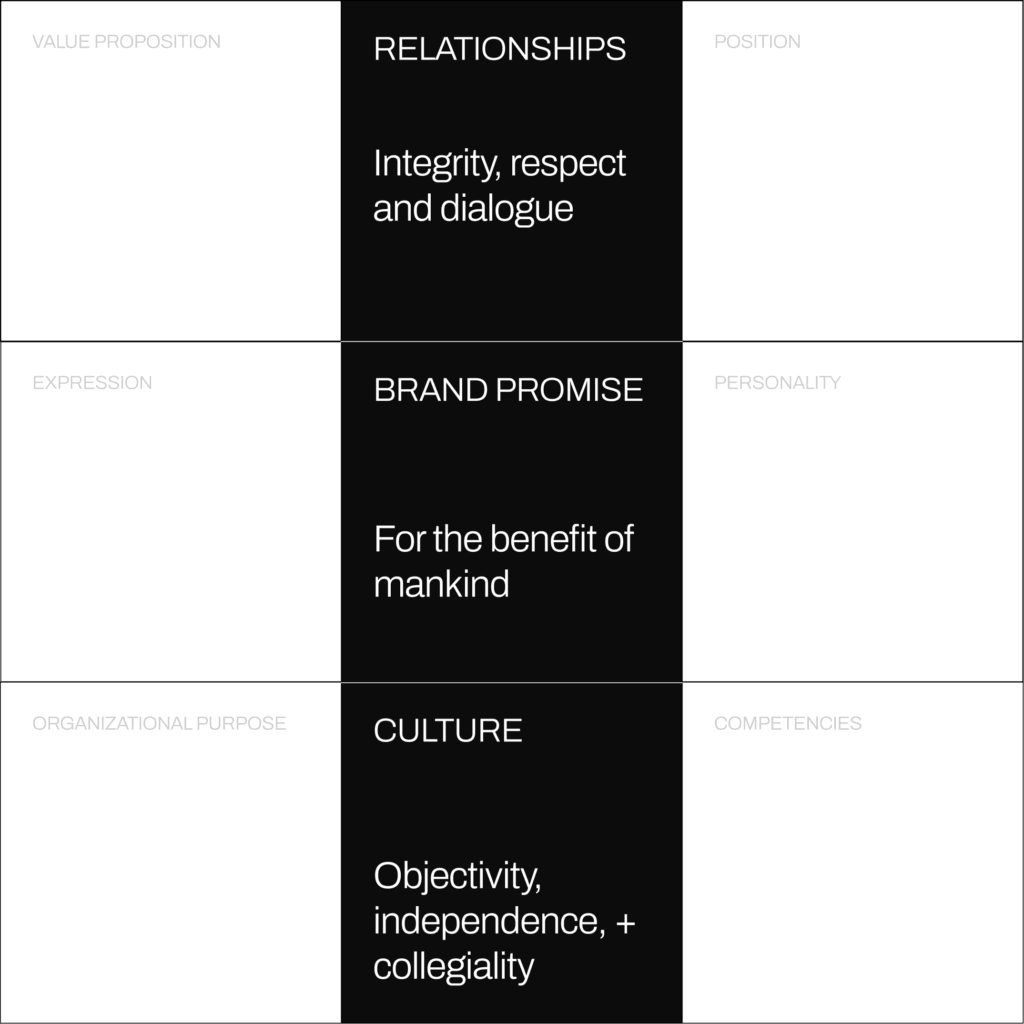
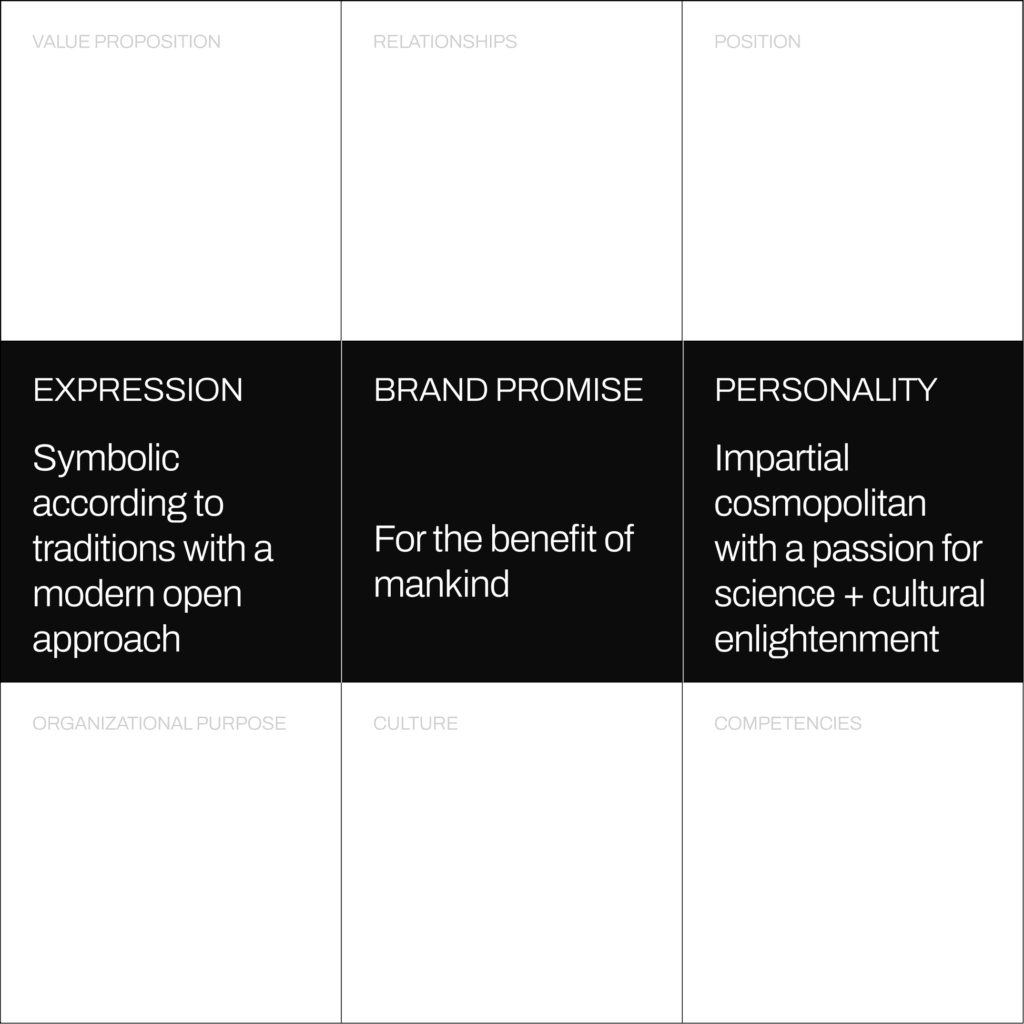
The Brand Promise is “for the benefit of mankind,” taken directly from Alfred Nobel’s will. That matters because the promise isn’t a slogan invented by a committee trying to sound profound. It’s the operating centre of the institution.
What Coherence Looks Like
On the Strategy path, the Organizational Purpose connects to the Brand Promise, and the Brand Promise connects to the Position. Alfred Nobel’s will functions as the foundational purpose.
The promise is carried forward through the awards. The position, widely understood as the world’s most prestigious award, isn’t simply asserted. It has been earned through more than a century of repeated delivery.
On the Differentiation path, the Value Proposition is supported by real Competencies. The Nobel Prize can credibly stand for discovery, excellence, and higher ideals because rigorous, independent, and highly respected selection processes sit underneath the promise.
On the Interaction path, the Culture and Relationships reinforce the Promise through integrity, respect, dialogue, objectivity, independence, and collegiality. These are not decorative values. They’re part of what allows the institution to maintain legitimacy across generations.
On the Character path, the Expression and Personality also hold together. The Nobel Prize is symbolic, traditional, and modern in its public expression, while its personality can be understood as impartial, cosmopolitan, and committed to science and cultural enlightenment.
The point isn’t that every organization should behave like the Nobel Prize. Please don’t take that away from this. Most companies don’t need to carry the solemn weight of a century-old global institution every time they update a landing page.
The point is that the system holds. When you pull on one element, the others answer back.
- The promise is supported by purpose.
- The position is earned through delivery (promise).
- The competencies justify the value proposition.
- The expression reflects the personality.
- The relationships are supported by culture.
That’s what coherence looks like in practice. Not perfect wording, but structural honesty.
Where Brands Usually Break
After running the Matrix with more than 100 organizations over the last seven years, the same failure patterns show up again and again.
- A Brand Promise that’s aspirational but undeliverable. The language sounds good. Leadership likes it. The team can imagine a future where it becomes true. But the competencies, resources, systems, behaviours, or culture required to deliver it have not been built yet. Everyone can feel the gap, but the brand process sometimes gives people permission to call the gap ambition.
- A Culture that contradicts stated values. This is one of the fastest ways to lose trust internally and externally. The website says one thing. The decision-making culture says another. Employees are then asked to perform a promise the organization doesn’t consistently support.
- A Positioning disconnected from Competencies. This usually happens when positioning is built externally without a sufficiently honest internal audit. The market opportunity may be real, and the position may be desirable, but the organization doesn’t yet have the capability, specialization, proof, or delivery model required to sustain it.
- Expression is inconsistent across channels. This is often blamed on poor governance, but the deeper problem is usually that Personality was never clearly defined. Without a shared sense of character, every team interprets the brand differently, and they all think they’re right.
- The Organizational Purpose is weak or absent. Without a real internal source of meaning, the Brand Promise has nothing to draw from. The system becomes a set of external claims with no roots underneath them.
- The Expression is treated as the work itself. This one is everywhere. Teams translate internal strategic language directly into external messaging and end up with copy that sounds like a paragraph from a brand brief instead of a point of view the organization has earned. The Expression cell should usually be one of the last things to resolve. In many brand processes, it’s the first thing everyone wants to see.
Again, I understand why. Expression is tangible. It’s exciting, feels real and gives people something to react to. But if the internal system is unresolved, expression becomes a very convenient way to avoid the harder conversation.
What the Matrix Does Differently
The Matrix doesn’t ask whether the brand sounds good. It asks whether the organization is built to make the brand true.
That’s why I keep coming back to the idea of the lie detector test. Not because most organizations are deliberately lying, although some are more comfortable with theatre than they should be, but because most organizations are full of small, accumulated gaps between aspiration and reality.
A promise that has not been operationalized. A position that has not been earned. A value proposition that’s not supported by distinctive competencies. A culture that can’t sustain the relationship the brand claims to want. An expression system that looks polished but doesn’t reflect a coherent personality.
The Matrix makes those gaps visible. And that visibility changes the nature of the conversation. Brand stops being only about marketing, communications, or design, and becomes a C-suite conversation about what the organization is actually prepared to do.
That’s the part I think matters most. Because the Matrix doesn’t just produce better language, it forces better accountability.
It can support a rebrand, obviously. It often does. But treating the Matrix as a rebrand tool undersells it.
The Matrix is more useful as an operating system for brand coherence. It can help audit an existing brand. It can pressure-test a new strategy before launch. It can onboard leaders into a shared understanding of what the brand actually is. It can help evaluate whether a new product strengthens or strains the promise. It can reveal whether a merger is creating identity conflict. It can guide AI governance by clarifying what the brand should and should not generate at scale.
If AI is going to accelerate brand expression across marketing, sales, support, product, HR, and customer experience (which it will), then the organization needs something deeper than a tone of voice guide and a folder of approved phrases. It needs a coherent system for deciding what is true, claimable, earned, and what should not be said yet.
The Matrix gives that conversation a structure. Not a perfect one, because no framework is magic, and anyone who tells you otherwise is probably trying to sell you something. But a useful and serious one that forces the organization to connect the thing it wants to say with the thing it’s actually built to do.
Ambition Still Matters, But Sequence Matters More
There’s a predictable objection here: does this make brand strategy too conservative?
I don’t think so, although I get the concern. The point isn’t to strip ambition out of the brand. Brands need ambition. Organizations need direction, and a strong position should create movement. A good promise should stretch the organization toward a better version of itself.
The line often attributed to Henry Ford applies here, even if the attribution itself is a little slippery: if he had asked people what they wanted, they would have said a faster horse. Whether or not he actually said it’ i’s less important than the point underneath it. Customers are very good at describing present frustrations, current behaviours, unmet needs, and the language they use to make sense of the world. They’re rarely equipped to imagine—or articulate—the next paradigm on your behalf.
That’s why an over-reliance on measurement can become its own kind of strategic laziness. Research matters. Qualitative data and customer insights matter. But you can’t fully measure forward. You can use research to validate tension, understand context, identify patterns, sharpen language, and pressure-test whether a proposed direction has resonance, but at some point, leadership has to make a judgment about where the organization is going and what it’s willing to become.
So no, the Matrix isn’t an argument for timid brand strategy, and it’s not a request to let the market vote on your future until every interesting edge has been sanded off and sterilized. The Matrix isn’t trying to protect organizations from ambition. It’s trying to protect them from mistaking ambition for readiness.
There’s a difference between useful stretch and strategic delusion.
Think of it like an elastic band between what the organization can currently deliver and where it wants to go. Some tension is good because it creates energy and gives the organization something to move toward. But stretch it too far and it stops being motivating. It becomes dishonest. Employees feel it first because they’re the ones asked to perform the gap. Customers feel it next because they’re the ones asked to believe it.
That’s where the Matrix becomes practical.
It helps leadership distinguish between a position the organization can claim now, a position it can credibly build toward, and a position it has no business claiming until the internal system changes.
That’s not a lack of vision. It’s sequencing. And in a market where everyone can sound convincing, sequencing might become one of the most underrated forms of brand discipline.
The Conversation Brand Teams Need to Earn
Most marketing people want brand to be taken more seriously inside the organization. Fair enough. They should.
But the way to earn that seat isn’t by insisting that brand is important. Everyone already says that. The way to earn the seat is by showing that brand is where the organization’s promises, behaviours, competencies, culture, and market position either hold together or start to come apart.
That’s a different conversation.
It’s not “we need a clearer message.” It’s “our external claims are drifting away from our internal reality.”
It’s not “we need a stronger tone of voice.” It’s “our expression has no coherent personality underneath it.”
It’s not “we need a better positioning statement.” It’s “we are claiming a position our current competencies don’t support.”
It’s not “we need more consistency.” It’s “we have not agreed on what the promise actually requires from the organization.”
That’s how brand moves from marketing to the C-suite.
Not by making brand sound more important, but by making it impossible to separate brand from organizational truth.
Next: Trust When Credibility Is Cheap
In the first piece, we looked at how AI is making external legitimacy cheaper. In this one, we looked at the Matrix as a way to find the gap between what an organization promises and what it can actually deliver.
The next question is what happens after you find the gap. Because diagnosis isn’t the point, trust is.
In the next piece, we’ll look at what it means to earn trust in a world where polished expression is everywhere. What does proof look like when a nice website no longer proves very much? How should marketing, product, support, sales, operations, and leadership carry the same promise without flattening the organization into a rulebook? How do you give teams the power to act on the brand without letting the brand fragment into a hundred interpretations?
That’s where this gets practical. Because once credibility is cheap, trust has to be earned somewhere else. And increasingly, that somewhere else is everywhere.
Sources + Further Reading
- Part 1: AI Is Commoditizing Brand Legitimacy
- Part 3: The Trust Continuity Audit for Brands in the AI Era
- Stephen A. Greyser and Mats Urde, “What Does Your Corporate Brand Stand For?”, Harvard Business Review
- Mats Urde and Stephen A. Greyser, “The Nobel Prize: The Identity of a Corporate Heritage Brand,” Journal of Product & Brand Management
- “The Brand Matrix: Corporate Brand Leadership Starts From The Inside. ” Amazon
- Post 2: Your Brand Is Not a Stack
- “Corporate Brands with a Heritage,” Mats Urde, Stephen A. Greyser, and John M. T. Balmer (2007)
- The Brand Matrix: Corporate Brand Leadership Starts from the Inside, Dr. Mats Urde (2024). Available on Amazon
- About Mats Urde, originator of the Corporate Brand Identity Matrix. Brand Orientation
- Mats Urde, Associate Professor of Strategic Brand Management, Lund University. Research profile
What is the Corporate Brand Identity Matrix?
The Corporate Brand Identity Matrix is a framework for testing whether an organization can deliver what its brand claims. It maps nine elements across three layers (Internal, Bridge, and External) with the Brand Promise at the centre, and works less like a brand-building canvas and more like a lie detector for the gap between claims and reality.
Read Your Brand is not a Stack to learn more.
Who created the Corporate Brand Identity Matrix?
What's the difference between a corporate brand and a product brand?
A product brand is judged mostly on the offering: what it does, who it’s for, why it’s better. A corporate brand is the whole organization being judged over time, including culture, leadership, competencies, behaviour under pressure, and whether stakeholders can trust it. The Matrix was built for that larger problem.
Read Your Brand is not a Stack to learn more.
What are the nine elements of the Brand Matrix?
The External layer holds Value Proposition, Relationships, and Position. The Internal layer holds Organizational Purpose, Culture, and Competencies. The Bridge layer holds Expression, Personality, and the Brand Promise, which sits at the centre because every other element should support it or be tested against it.
Read Your Brand is not a Stack to learn more.
What are the four diagnostic paths in the Brand Matrix?
Strategy (Purpose through Promise to Position), Differentiation (Value Proposition through Promise to Competencies), Interaction (Culture through Promise to Relationships), and Character (Personality through Promise to Expression). Each path asks the same underlying question: does the system hold when pressure is applied?
Read Your Brand is not a Stack to learn more.
What are the four diagnostic paths in the Brand Matrix?
Strategy (Purpose through Promise to Position), Differentiation (Value Proposition through Promise to Competencies), Interaction (Culture through Promise to Relationships), and Character (Personality through Promise to Expression). Each path asks the same underlying question: does the system hold when pressure is applied?
Read Your Brand is not a Stack to learn more.
Is the Brand Matrix only useful for a rebrand?
No. It can audit an existing brand, pressure-test a strategy before launch, onboard new leadership, evaluate whether a new product strengthens or strains the promise, surface identity conflict in a merger, and guide AI governance by clarifying what the brand can credibly claim at scale.
Read Your Brand is not a Stack to learn more.
How is the Brand Matrix different from frameworks like the Golden Circle or StoryBrand?
Most brand frameworks help organizations articulate purpose, position, or messaging. The Matrix tests whether the organization behind the articulation can actually deliver it. A positioning statement can sound sharp without being operationally defensible. The Matrix forces external claims and internal realities into the same room.
Read Your Brand is not a Stack to learn more.