
Go to content

Branksome Hall

INTRODUCTION

A Global Education, Reimagined Digitally

Branksome Hall is Toronto’s only all-years International Baccalaureate World School for girls—an institution defined by academic excellence, international mindedness, and a deep commitment to innovation. From Junior Kindergarten through Grade 12, Branksome prepares students not just to succeed, but to lead with purpose.

Yet while the school’s vision was forward-looking, its digital presence lagged behind. Built on a restrictive CMS and fragmented across multiple microsites, the website struggled to serve its diverse audiences—prospective families, students, employees, alumnae, donors, and the broader community. Key stories around innovation, wellbeing, and impact were difficult to surface, and managing content had become increasingly complex.

Takt was engaged to lead a comprehensive website redesign and redevelopment—moving Branksome off Blackbaud and onto WordPress, unifying its digital ecosystem, and creating an experience that reflected the school’s leadership in girls’ education and innovation.

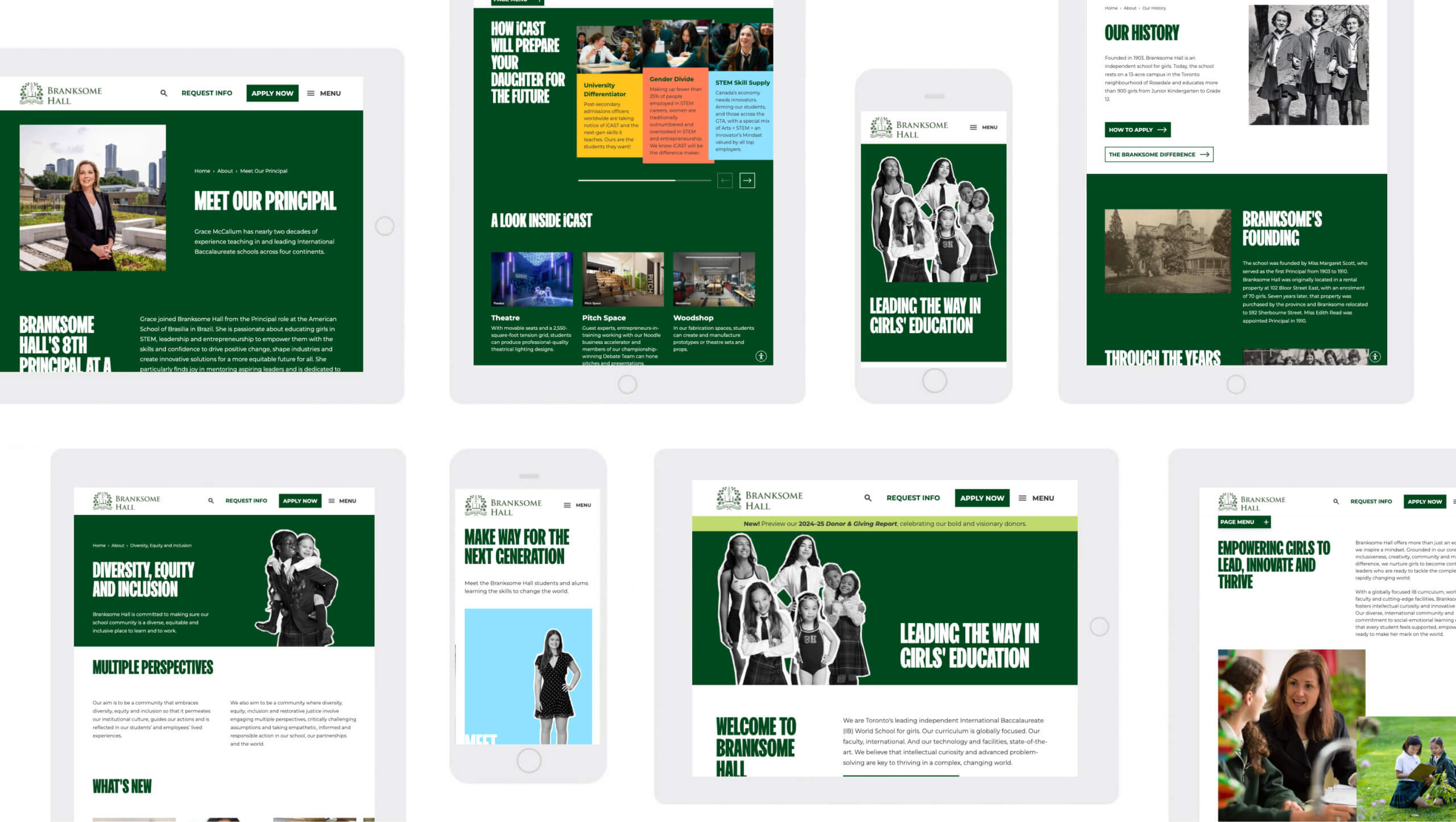
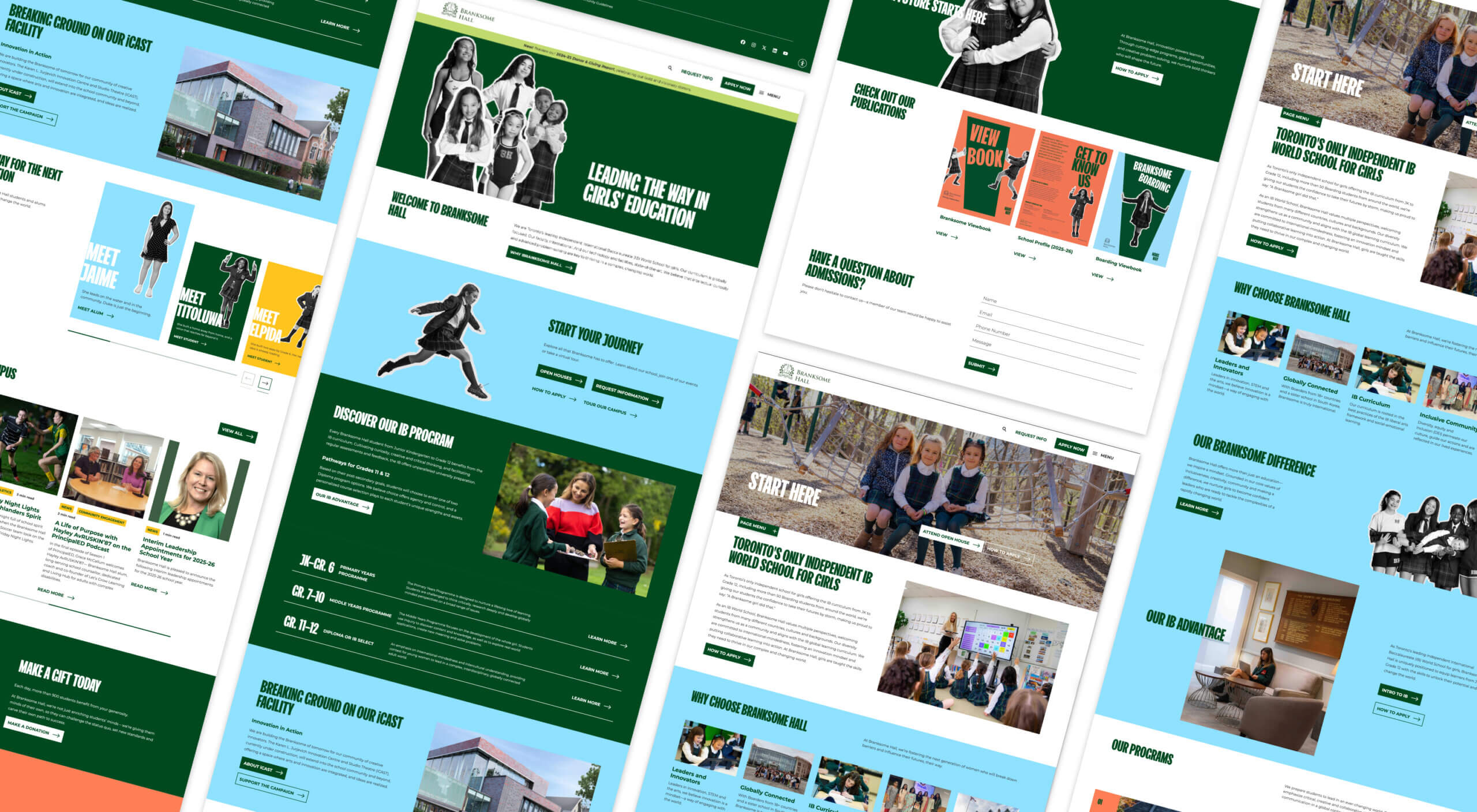
Responsive desktop and mobile screens from the Branksome Hall website design and development project.
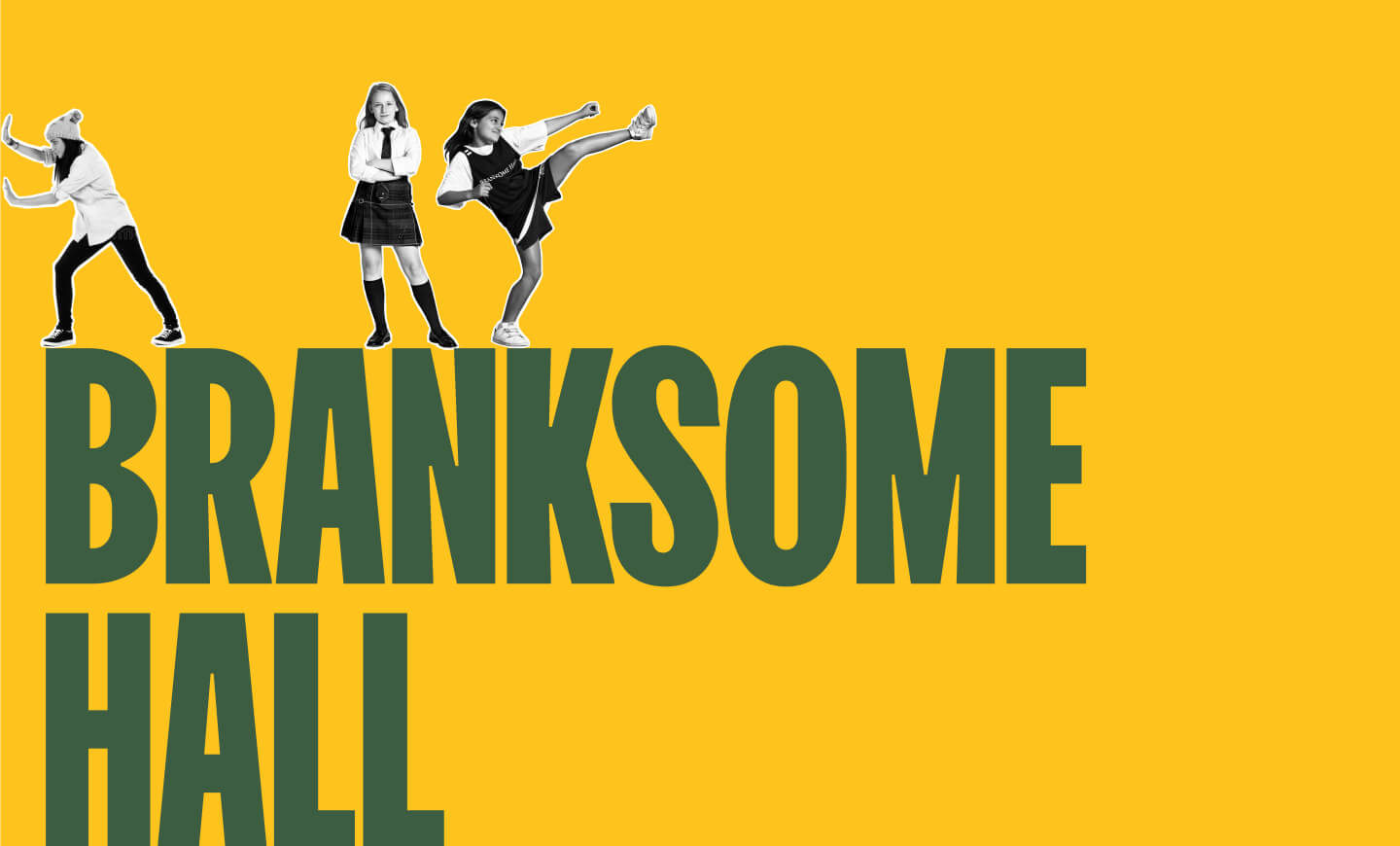
The Branksome Hall homepage. Website designed and developed by Takt.

Designing for Many Audiences, One Purpose

Branksome’s website needed to do many things well—often at the same time. Admissions content had to be compelling without overshadowing broader school life. Donor and community stories needed space alongside academic programs. Employees and alumnae required clear, functional pathways without wading through admissions-first messaging.

Our first priority was experience design. We re-architected the site around distinct audience journeys, aligning each segment with its primary motivations and actions. Prospective families encounter a narrative-led path that balances IB rigor with wellbeing, innovation, and campus life. Employees are guided quickly to culture, values, and opportunities. Alumnae and community members are surfaced as active contributors to Branksome’s ongoing story—not an afterthought.

The result is a site that feels intuitive and generous, without feeling diluted. Every page knows who it’s for—and why it exists.

A collage of pages across the Branksome Hall website. Designed and developed by Takt.
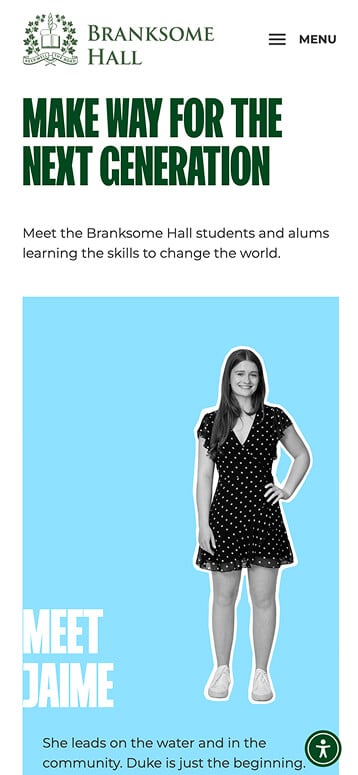
Branksome Hall's website on mobile. Designed and developed by Takt.
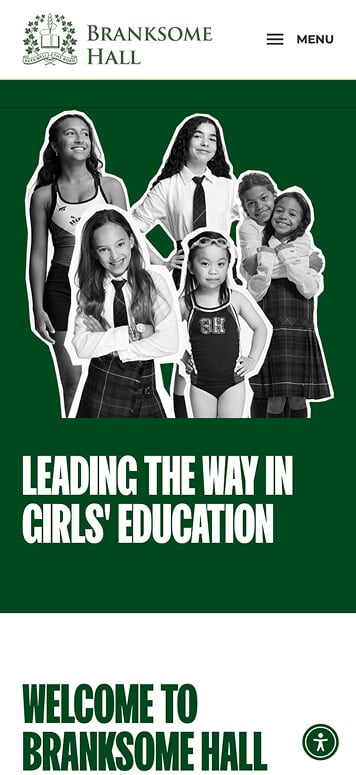
Branksome Hall homepage on mobile. Designed and developed by Takt.
Takt's work for Branksome Hall. Responsive homepage on mobile screen.
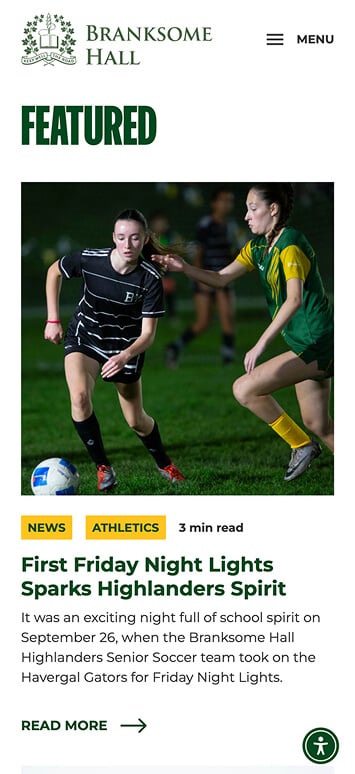
Featured news module on the new Branksome Hall website. Designed and developed by Takt.
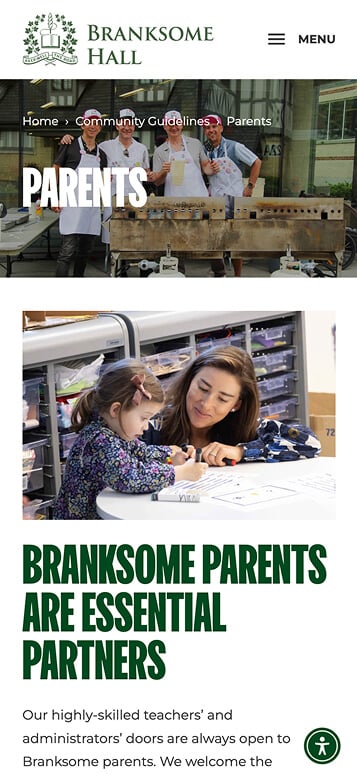
A page for parents on the Branksome Hall website. Designed and developed by Takt.

Bringing Innovation to the Foreground

Innovation is not a slogan at Branksome; it’s a strategic priority. With a major fundraising campaign underway to support a new innovation facility, the website needed to visibly embody this focus—not just talk about it.

We worked closely with the Branksome team to translate innovation into digital form. Large-scale imagery and video bring learning environments to life. Content authored by the Chandaria Research Centre is surfaced and contextualized. Stories of student-led inquiry, STEM and STEAM programming, and interdisciplinary learning are woven throughout the experience.

Rather than isolating innovation in a single section, it’s expressed as a throughline—embedded across academics, student support, community engagement, and future-facing initiatives.

The Programs page on Branksome Hall's website. Communicating important information through information architecture and beautiful design. Designed and developed by Takt.

Unifying a Fragmented Digital Ecosystem

A critical challenge was consolidation. Over time, Branksome had accumulated multiple standalone WordPress microsites—for camps, swimming, venue rentals—alongside separate shop experiences and Blackbaud-hosted pages. This fragmentation created friction for users and overhead for staff.
We migrated more than 450 pages of legacy content into a single, cohesive WordPress platform, preserving SEO equity while dramatically improving usability and governance. Events, registrations, news, and publications now live in one system, supported by custom post types and a clear content hierarchy.

In parallel, we reimagined Branksome’s e-commerce experience—merging the uniform shop and alum shop into a unified Shopify platform, visually aligned with the main website and designed to support both online and on-campus retail operations.

RESULTS

A Platform Built for the People Who Run It

Behind the scenes, the site was designed to work just as hard for Branksome’s internal team. With a small communications staff managing a high volume of content, the CMS needed to be flexible without becoming fragile.

We implemented a modular design system that empowers content authors while maintaining consistency. Global components reduce duplication. Templates accommodate multilingual expansion. Performance, mobile optimization, and WCAG 2.2 accessibility were baked into the build from day one—not treated as checkboxes at the end.

Branksome Hall’s new website reflects who they are today—and where they’re headed next. It positions the school as a national and international leader in girls’ education, grounded in IB excellence and propelled by innovation.

RELATED PROJECTS

VIEW ALL CASE STUDIES

Frequently Asked Questions

Common questions about education website projects, answered from experience.

How long does an education website redesign take?

Most education website redesigns take 9–18 months, with around 12 months being typical for higher education. The timeline isn’t driven by design alone—it’s shaped by scale, complexity, and how decisions get made inside academic institutions.

Time is most affected by three things: content volume and governance (often 100–250+ pages requiring departmental and faculty review), technical and UX complexity (accessibility standards, CMS governance, integrations, and IT approvals), and stakeholder structure (multiple decision-makers, committees, and limited availability around the academic calendar). The more layers involved, the more important sequencing and coordination become.

We address this early through a structured Research and Discovery phase that maps stakeholders, approval paths, and real capacity before timelines are locked. Schools that clarify decision-making and content ownership upfront often finish closer to 12 months; those that uncover complexity later tend to extend toward 18.

What makes an education program template work well?

A strong education program template balances usability, academic rigour, and regulatory requirements, while remaining flexible enough to evolve over time. The best templates don’t try to say everything at once; they guide users toward what matters most, with clear paths to deeper academic detail when they’re ready.

At Takt, we define those requirements early in Research and Discovery and design program templates using modular, atomic components. This allows content to be structured intentionally, reused consistently, and optimized over time without breaking governance or performance standards.

Effective program pages start with clearly defined Minimum Viable Content (MVC): the essential information a prospective student needs to understand the program, trust its credibility, and decide whether to explore further. It’s not about saying everything, but rather it’s about saying the right things, in the right order.

What does a full education website redesign project typically include?

A full education website redesign typically includes strategy, experience design, content planning, design, development, and launch, sequenced to reduce risk and align complex stakeholder groups. At Takt, we begin by clarifying your institution’s positioning and messaging, then translate real user needs into clear UX and Authoring Experience (AX) requirements that define journeys, content, and functionality.

Designs and user flows are validated early through testing before moving into development, content migration, and QA across multiple sprints, with decisions informed by both qualitative insight (interviews, workshops) and quantitative data (analytics, surveys). This approach is reflected in our work with New York University’s Webby Award–winning Casa Italiana website.

How should education websites handle events and programming calendars?

Education websites should treat events and programming calendars as discovery tools, not dumping grounds. The goal is to help different audiences quickly find what’s relevant to them, while preserving performance, clarity, and SEO.

We design event systems with clear taxonomy, filtering, and modular templates so calendars scale without becoming overwhelming or outdated. Combined with strong governance and automation, this ensures events remain accurate, searchable, and useful over time.

How long does CAT typically take for a higher education website?

Higher education is its own category when it comes to CAT, and it needs to be planned accordingly. The realistic window is one to two months, and for larger, more complex institutional sites with multiple departments involved in content review, three months is not unusual.

Here’s why. Even though departmental content should have been reviewed and approved during the copywriting phase, seeing it live in the actual site environment, with real page layouts, navigation, and context, reliably surfaces additional rounds of review. Faculty and admissions teams want to confirm that program details, faculty profiles, and application information are accurate before the site is public. That’s legitimate. But coordinating that review across multiple departments, each with their own availability and priorities, takes time.

The academic calendar compounds this. CAT can’t be planned in isolation, it needs to be workbacked from a target launch date, with clear-eyed awareness of what else is happening institutionally. Are you trying to launch before the new academic year? Before a specific application deadline? Before or after convocation? Those dates shape everything, including when IT needs to be available to support the go-live. We map all of this at kickoff, so CAT doesn’t get scheduled into a window that doesn’t actually work.

What impacts an education project timeline the most, and how do we plan for it realistically?

Based on our experience across higher education projects, the two factors that control timeline most consistently are: decision-making structure, how many approval layers exist and how long they realistically take, and the academic calendar and the client team’s real capacity across it.

We build a detailed project timeline collaboratively at kickoff that accounts for all of these factors, including blackout periods, leadership review windows, and department consultation phases. Who has final approval authority, and how long do their review cycles realistically take? Are there known high-demand periods such as enrollment season, convocation, or board reporting cycles that compress the team’s availability? These questions need answers before the timeline is set, not after delays appear.

How do you ensure the brand strategy holds up under the pressures of a major fundraising campaign?

By treating advancement as a distinct priority segment during brand strategy development, not something layered on after the platform is finalized.

Fundraising campaigns put brand strategy under a particular kind of stress. Donor and alumni audiences require a different register than recruitment or research communications, and the stakes for consistency are higher when major gifts are on the line. The brand architecture needs to accommodate donor motivations (legacy, impact, belonging) without fracturing from the institutional narrative that serves prospective students or faculty recruitment. That means advancement teams should be at the table during strategy development, not brought in at the toolkit stage.

The brand platform should give them a clear, confident foundation to build campaign creative on rather than something they have to work around. We’ve built brand systems that account for fundraising pressures across institutions like Adler University, Branksome Hall, and Hagar International.