Go to content

Hagar International

A still from an awareness-raising video produced for Hagar International.

INTRODUCTION

Hidden in Plain Sight – A Video Campaign for Hagar International

Human trafficking is no longer a distant problem—it’s reaching us directly through the phones in our pockets. Scammers, often victims of trafficking themselves, are forced to send fraudulent messages, weaving a thread of connection between their suffering and the day-to-day lives of those they scam. This intersection of trafficking, scamming, and technology has created an urgent moment in time—a moment impossible to ignore.

Scamming has grown into a $3 trillion industry, fueled by the ubiquity of cryptocurrency, economic instability, and a hyperconnected global population. In Cambodia alone, organized crime syndicates operating scam compounds generate an estimated $14 billion annually. Victims, often recruited under false promises of legitimate work, are stripped of their passports, forced into horrific conditions, and subjected to violence if they fail to meet quotas. For many, escape is only possible if a ransom—sometimes as high as $70,000—is paid.

PARTNERSHIP

Partnering with Hagar to Shine a Light

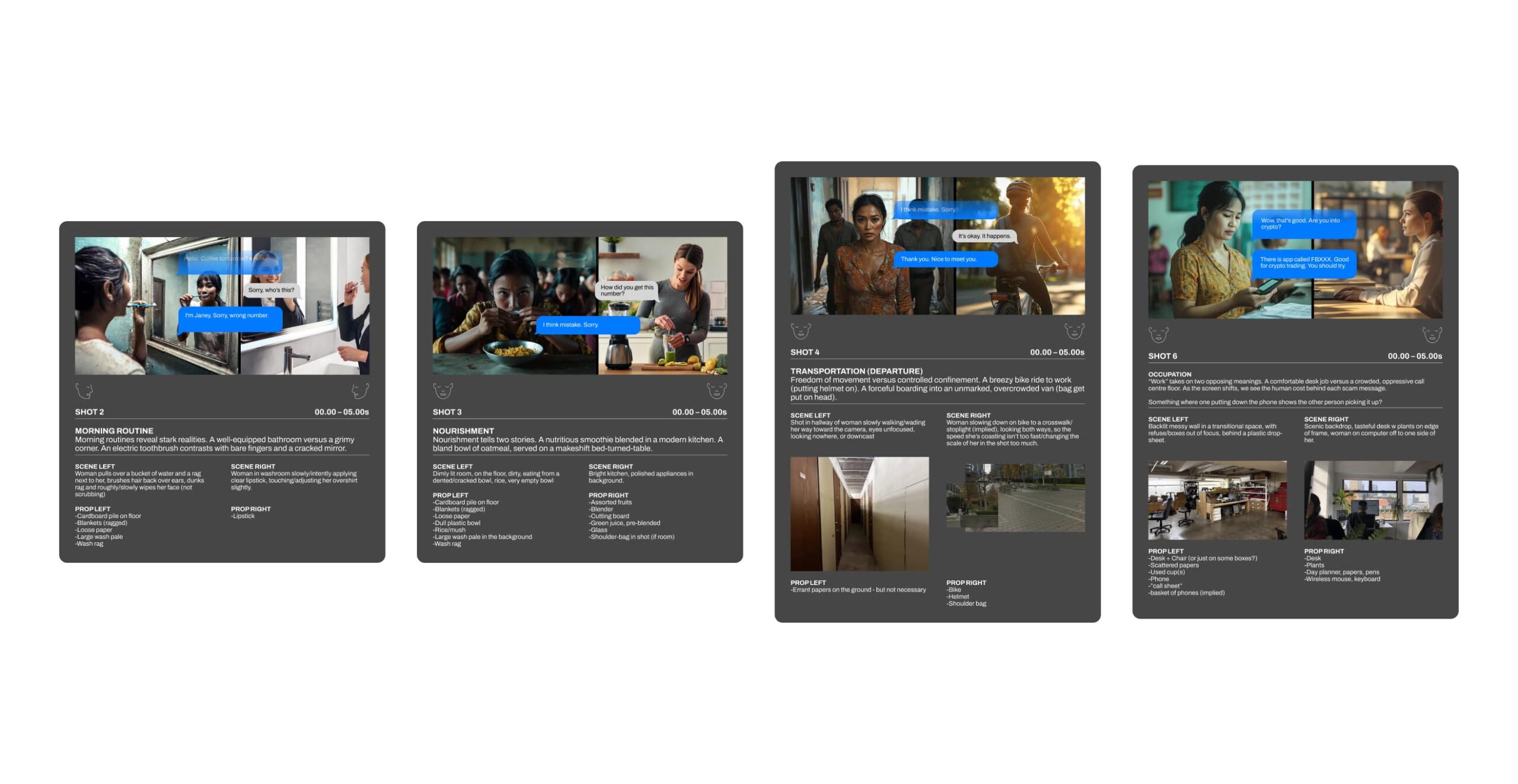
At Takt, we knew we could make a difference. We reached out to Hagar International, a global organization dedicated to combatting human trafficking, and proposed creating a pro-bono video to drive awareness and donations. Our pitch: a split-screen concept titled Hidden in Plain Sight that juxtaposes the life of a scam victim with the person they’re forced to scam.

Storyboards from pre-production for a humanitarian non-profit video production.

STORY DEVELOPMENT

A Day in Two Lives

The video follows two characters: on the left, a South Asian scam victim trapped in a compound; on the right, a North American woman living an aspirational life. The split-screen highlights stark contrasts: the victim sleeps on the floor, washes with a rag, and works under constant fear, while the North American enjoys fruit smoothies, a full makeup routine, and a bike ride to work.

At the story’s climax, the victim makes her move, sending a text about crypto investing. The viewer suddenly realizes the scammer is acting under duress—a forced participant in this global crisis. The video closes with powerful statistics, such as:

80% of text-based scams exploit human trafficking victims.
Over 2.5 million people in Southeast Asia are trapped in forced labor.

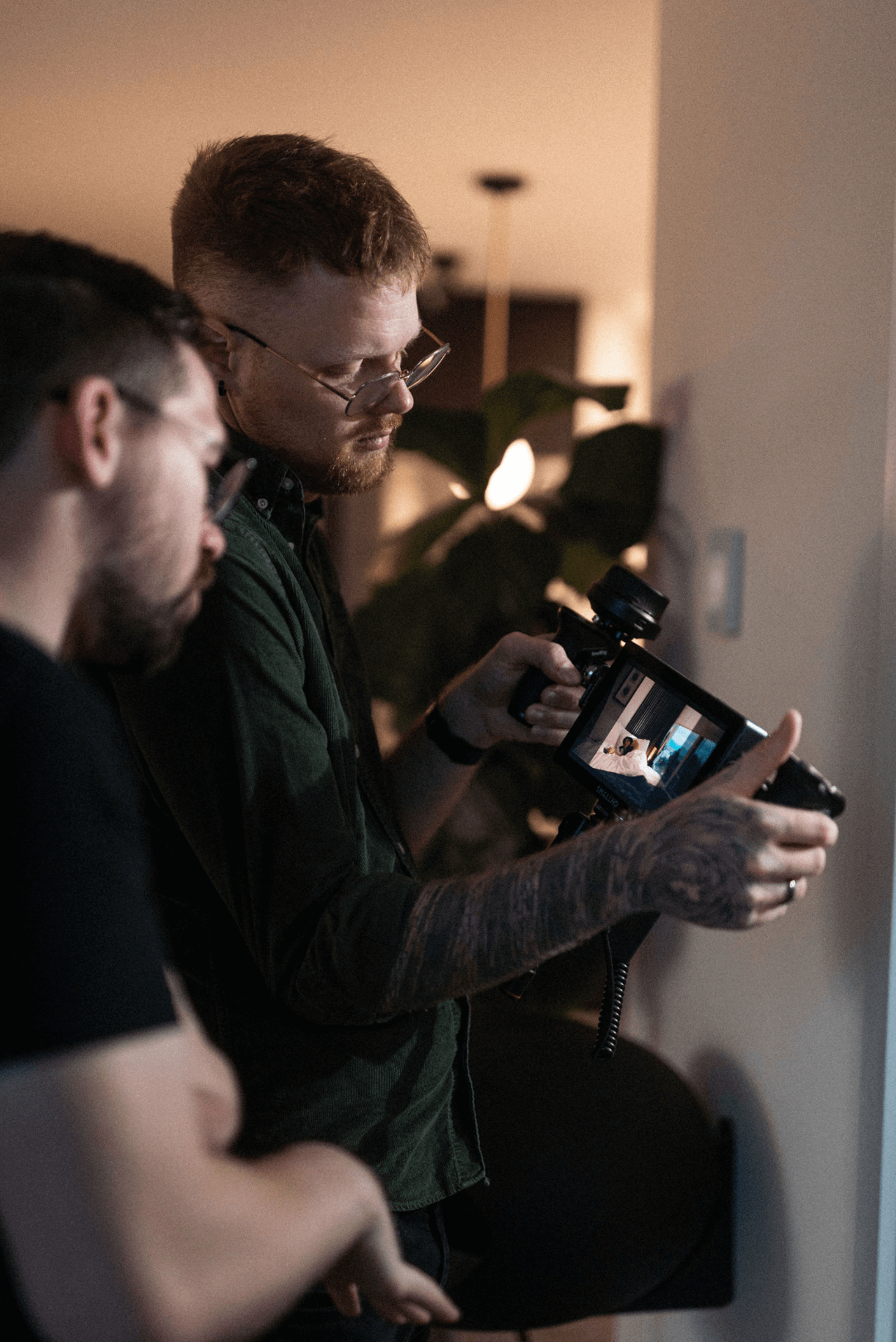
A camera set up on set during a humanitarian non-profit video shoot.
Behind the scenes of a bike scene during a humanitarian non-profit video shoot.
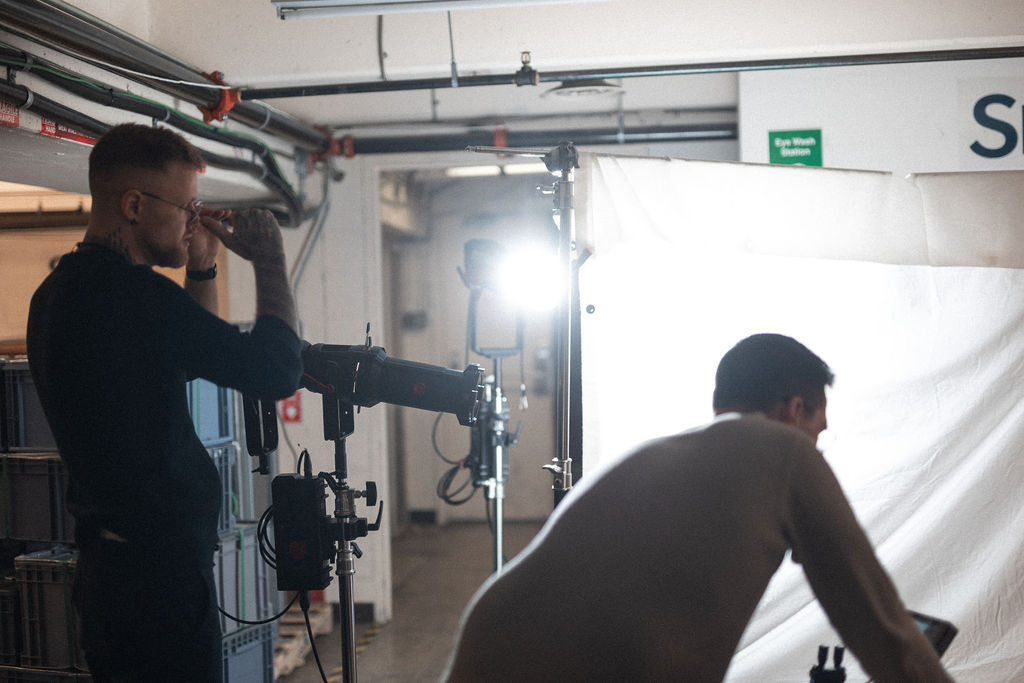
A behind the scenes photo during production of a humanitarian non-profit video.
A behind the scenes look at filming for Hagar International.
A creative director checking the shot while filming a humanitarian non-profit video.
Setting up a kitchen scene during a humanitarian non-profit video shoot.
A creative director and cinematographer collaborating on set for a humanitarian non-profit video.
Behind the scenes planning for a humanitarian non-profit video shoot.

BTS


The final cuts are stunning! The team did a beautiful job making this clear, easy to follow, and captivating. Thank you for all your hard work. I am speechless and cannot wait to release this!

Amie Gosselin, Fundraising + Communications—Hagar USA

PRODUCTION

Making It Happen

Bringing this story to life required immense collaboration and dedication. Two local actors graciously volunteered their time, while filming locations, including a commercial building under renovation, were carefully selected to replicate the conditions described in reports from scam compounds. Wardrobe and set design reflected the grim reality of these operations, contrasting sharply with the polished world of the North American character.


RESULTS

Impact + Awareness

Hidden in Plain Sight is more than just a video—it’s a call to action. As part of Hagar’s broader initiative to combat trafficking, it aims to inspire viewers to learn, donate, and act. By visiting Hagar’s campaign page, audiences can join the fight against forced scamming and human trafficking.

Also, a big thanks to our incredible talent, Proud Channara and Anabel Blesch who generously donated their time and talents to this project.

Related Projects

VIEW ALL CASE STUDIES

Frequently Asked Questions

Common questions about non-profit fundraising campaigns, answered from experience.

How do you ensure the brand strategy holds up under the pressures of a major fundraising campaign?

By treating advancement as a distinct priority segment during brand strategy development, not something layered on after the platform is finalized.

Fundraising campaigns put brand strategy under a particular kind of stress. Donor and alumni audiences require a different register than recruitment or research communications, and the stakes for consistency are higher when major gifts are on the line. The brand architecture needs to accommodate donor motivations (legacy, impact, belonging) without fracturing from the institutional narrative that serves prospective students or faculty recruitment. That means advancement teams should be at the table during strategy development, not brought in at the toolkit stage.

The brand platform should give them a clear, confident foundation to build campaign creative on rather than something they have to work around. We’ve built brand systems that account for fundraising pressures across institutions like Adler University, Branksome Hall, and Hagar International.

How do you identify and manage project risk?

During scoping and statement of work development, we work with the client team to surface known risks and build mitigation strategies into the project plan from day one. That means naming approval complexity, academic calendar constraints, content ownership gaps, and IT dependencies before the project starts, not after they cause delays.

The risks that most commonly impact institutional rebrands fall into four categories. Stakeholder alignment risks, where decision-making is unclear or direction conflicts across the steering committee. Capacity risks, where team bandwidth on the client side doesn’t match what the project actually demands at key phases. Scope risks, where new requirements emerge mid-project without a clear process for evaluating and absorbing them. And timeline risks, where approval layers or blackout periods weren’t mapped upfront and compress the phases that matter most.

Our mitigation approach comes down to three principles we establish from the start: codifying a decision-making North Star before creative exploration begins, so the work always has something defensible to trace back to. Aligning stakeholders around decision criteria rather than preferences, so feedback stays strategic rather than personal. And using data diagnostically, to interrogate and pressure-test, rather than directionally, so research informs judgment rather than replacing it.

How do you keep feedback strategic and aligned internally?

Early in the project, we establish a shared set of decision criteria with the core executive team: what does the new brand need to achieve and what does success actually look like?

These criteria become the lens through which all creative and strategic work is evaluated. When feedback comes, we facilitate the conversation by anchoring it to those criteria rather than allowing it to drift into subjective territory. “I don’t like that” becomes “does this reflect the authority and warmth we said we needed?”

In institutional projects, personal preference is often a proxy for very legitimate concerns. The risk isn’t that people have opinions, it’s that opinions get treated as equal inputs regardless of their strategic relevance. Decision criteria give everyone a shared language for evaluating the work.